This week’s New Pubs features Holliday et al on post-coup humanitarian engagement by both ‘regional’ and ‘international’ actors; Russell and Gaborit on gender and the post-coup reconsideration of how hpon can be polluted; and an edited volume on youth, community, and democracy with eight chapters on Myanmar.
See our Recent Publications page for all of the citations and for past weeks, and if anyone wants a PDF but is excluded by pay wall, please email us and we will help if we can.
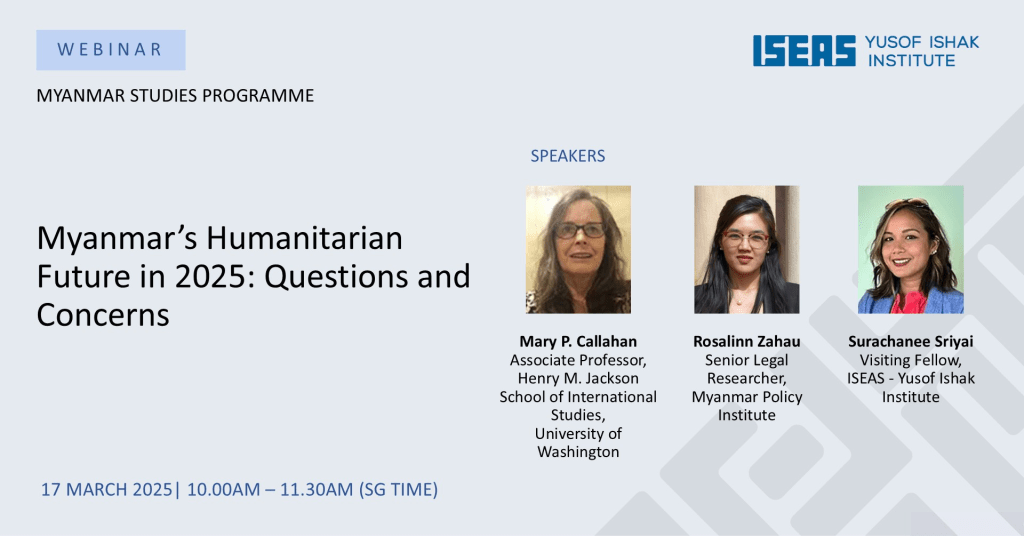
The Trump Administration’s sweeping cuts to scholarship grants for Myanmar students and programmes for refugee resettlement and humanitarian assistance for communities affected by the ongoing conflict in Myanmar have added more uncertainties and challenges to the country’s humanitarian crisis, which has spiralled since 2021. Communities in the hard-to-reach regions in Myanmar face a bleak future, as do many young people whose education and employment prospects were disrupted by the 2021 coup, and exacerbated by conscription enforcement since 2024. The abrupt withdrawal of assistance has also left neighbouring and other donor countries with added challenges to filling the funding gap for Myanmar’s urgent needs. In this webinar, a long-time Myanmar watcher and scholar, and researchers working on aspects of Myanmar’s humanitarian needs and responses will discuss questions and concerns arising from the aid cuts in 2025.
About the Speakers
Mary P. Callahan is associate professor in the Henry M. Jackson School of International Studies at the University of Washington. She teaches classes on Southeast Asian politics, Human Rights in Asia, and The Politics of Development Assistance. On leave from the university, she spent twelve years based in Yangon, Myanmar, where she carried out extensive research on electoral politics, gender and conflict, and foreign assistance politics. She is currently working on a book manuscript on revolutionary politics in the Dry Zone.
Rosalinn Zahau is Senior Legal Researcher at the Myanmar Policy Institute, an independent and non-profit organisation. Her prior professional experience includes stations with local and international NGOs in South and Southeast Asia and the US. Before the 2021 coup, Rosalinn worked in Myanmar as a human-rights-focused research consultant and program officer for various non-profit organizations. Since 2021, she has worked on refugee rights, strengthening civil society groups, and protecting human rights in Myanmar.
Surachanee Sriyai is a Visiting Fellow with the Media, Technology and Society Programme at the ISEAS-Yusof Ishak Institute. She is also the interim director of the Center for Sustainable Humanitarian Action with Displaced Ethnic Communities (SHADE) under the Regional Center for Social Science and Sustainable Development (RCSD), Chiang Mai University.
Friday, March 14, 2025 7:00 PM – 9:00 PM EDT Union C (2nd Floor, Hyatt)
Each year the BSG holds a meeting to discuss awards, new projects, publications, and how BSG have spent your dues money this year (typically on supporting graduate students to attend AAS). It sounds formal, but is quite casual and is a good way to meet the Burma Studies scholars – all are very much welcome. We also recognize that not everyone can join physically, and so the BSG leadership has provided a virtual option as well.
Relatedly, please pay your dues. $10 for students, and $20 for non-student members goes a long way in aggregate. Donate here: https://members.asianstudies.org/donate-now (please choose “Burma Studies Group” and enter the amount. You can always give more! )
This week’s New Pubs features Saba and Akbarzadeh on China’s promotion of authoritarianism in Myanmar; Ganesan on why Thailand’s strategy of dealing with post-coup Myanmar deviates from ASEAN’s; and Soe Win on the impact of war on women’s lives in Burma.
See our Recent Publications page for all of the citations and for past weeks, and if anyone wants a PDF but is excluded by pay wall, please email us and we will help if we can.
Repositioning the Bamar identity in the context of establishing a Bamar state
The proposal to establish a Bamar state, introduced in 1961 in Taunggyi as part of ‘The Shan Federal Proposal’, aimed to promote equality among Burma’s eight major ethnic groups by assigning each group its state. This was seen as a potential solution to the civil war that had been ongoing since 1949. The idea emphasised equality within a democratic federation. However, it stalled after the military coup in 1962 and remained dormant until 1988. The proposal re-emerged as a policy option at the Union Peace Conference – 21st Century Panglong, held from 31 August to 4 September 2016 in Naypyidaw, and gained attention during the 2021 revolution against the military regime.
Currently, organisations such as the Committee Representing Pyidaungsu Hluttaw (CRPH), the National Unity Government (NUG), and the National Unity Consultative Council (NUCC), along with key ethnic armed organisations like the Kachin Independence Army (KIA), Arakan Army (AA), and Karen National Union (KNU), have not formally adopted this proposal. However, some armed forces formed after the 2021 coup, bearing the identity of Bamar, such as the Bamar People’s Liberation Army (BPLA), the Burma Liberation Democratic Front (BLDF), the Burma National Revolutionary Army (BNRA), and the Bamar Army founded in 2025, endorse the creation of a Bamar state in their founding statements and position papers. This idea is also included in the ‘Standard Federal Constitution of the Federal Union of Myanmar’, issued by the Federal Law Academy on 11 January this year. Online discussions organised by these stakeholders have shown support for this concept. However, the current identity politics within the revolutionary context underscores the urgent need for a clear plan to implement this agenda.
A critical issue that demands immediate attention is defining who will constitute the members of the proposed Bamar state and who will be recognised as Bamar ethnic people eligible for representation and entitlements within the proposed federation. This presentation aims to outline the evolution of Bamar identity over time and explore its role in the ongoing debate regarding establishing a Bamar state as a necessary solution to Burma’s protracted civil war.
Speaker
Phyo Win Latt began his career as a freelance journalist in 2003 before joining the local business magazine Living Color. There, he initially served as a reporter and later advanced to the role of editor at The Voice Weekly, also published by Living Color Media Group. In 2005, he enrolled in the Master of Arts program in International Development Studies at Chulalongkorn University, completing his degree in 2006.
For the past 15 years, Phyo has lived in Thailand, Malaysia, Brunei, and Singapore, engaging in various studies, professional endeavours, and volunteer activities with organisations dedicated to human rights, migrant issues, and refugee affairs. During this time, he gained invaluable experience working alongside journalists, politicians, academics, political and human rights activists, students, and trade unionists in multiple countries, including Thailand, Malaysia, Singapore, Indonesia, and the Philippines.
In 2020, he was awarded a PhD in history from the National University of Singapore, with his thesis titled ‘Protecting Amyo: The Emergence of Xenophobic Nationalism in Colonial Burma (1906-1941)’. Chair: Zaw Yadanar Hein, zaw.hein@anu.edu.au
This week’s New Pubs features Myanmar Witness’s report on post-coup violence in Sagaing; Nyi Nyi Kyaw assessing Rohingya opportunities after the coup; and Dudley writing on the postcolonial narratives inscribed in Myanmar’s museums.
See our Recent Publications page for all of the citations and for past weeks, and if anyone wants a PDF but is excluded by pay wall, please email us and we will help if we can.
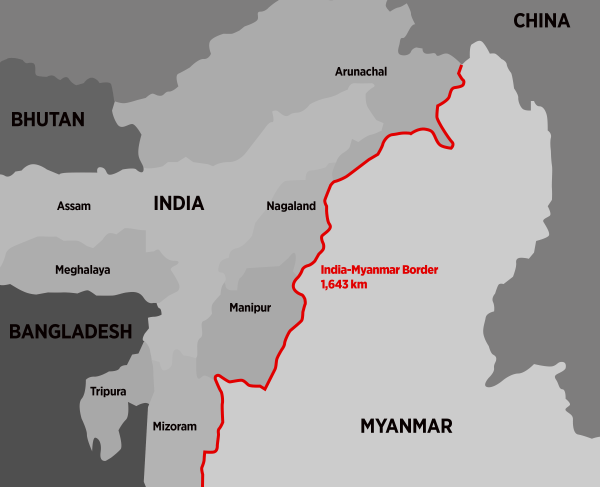
This week’s New Pubs features Mansaray et al on international migration away from Myanmar; Pum Khan Pau’s book on insurgency on the India/Myanmar “borderland” in years 1914 to 1945; and Htet Hlaing Win on political killings in post-coup Myanmar.
See our Recent Publications page for all of the citations and for past weeks, and if anyone wants a PDF but is excluded by pay wall, please email us and we will help if we can.
Myanmar, part of British India until 1937 | map source: internet
In this wide-ranging interview with Aurore Candier, the new director of the Burma Studies Center of NIU (and accompanied in this conversation by the out-going director, Catherine Raymond), the discussion touches on everything from evolutions in Burmese language, to histories of divination, to how to study Myanmar.






 Burma Studies Group