Our most recent DC (#15, see here) discusses different Burmese conceptions of the (feminine) body. This week there is a debate between two of the revolution’s two iconic influencers / leaders / gadflies: Thinzar Shunlei Yi critiques weaponizing the htamein, and then a response from Pancelo (who refers to herself as စပပျံ whilst trolling generals) for her own take.
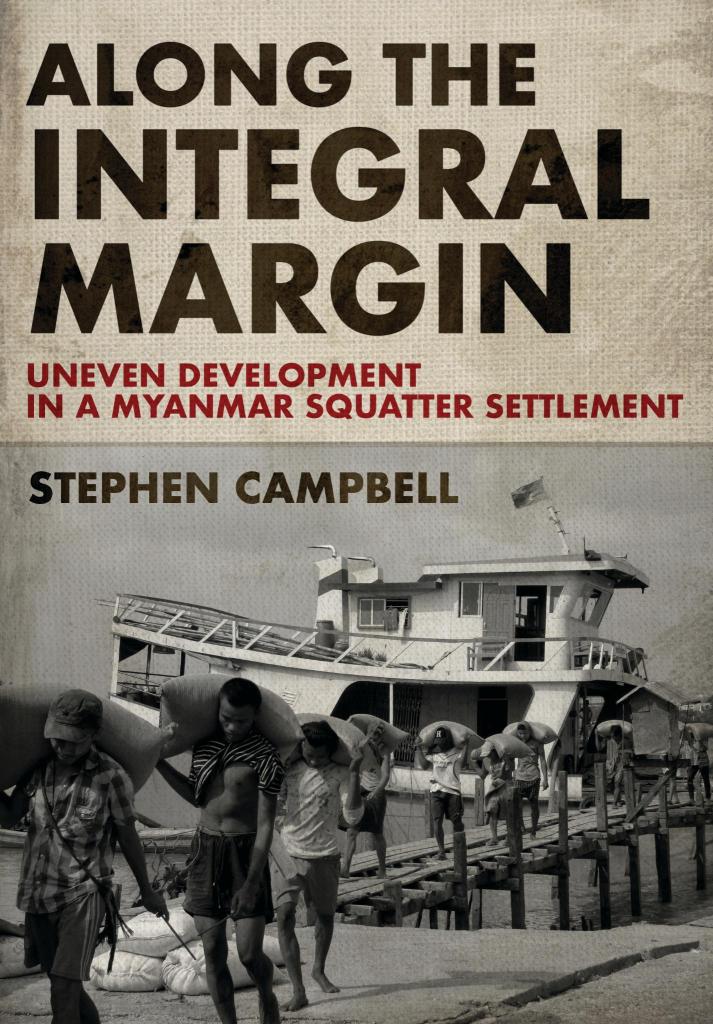
This week we feature Ardeth Thawnghmung on Myanmar’s concept of “National Races”; Yi Li on the failure of colonial British tin mine development in southern Burma, and Tønnesson, Min Zaw Oo, and Ne Lynn Aung on the way that EAOs use social media to project state-ness. See here for full citations and all the other recent publications.
with Saw John Bright, Myat Thet Thitsar, and Nick Cheesman
moderated by: Tamas Wells and Sophia Htwe, 12:00-1:30pm AEST
Description
In Myanmar, research has long been associated with challenges and questions in terms of ethics and practice. With a history of successive authoritarian regimes and earlier colonial occupation setting the stage for more extractive research relationships, researchers—both international and domestic—have continued to conduct research in the face of harsh restrictions. In addition, university research ethics processes are not necessarily able to adapt to the complexity of fieldwork in dynamic contexts, with international fieldwork a noted challenge. Since the military coup in February 2021 ended a decade of more democratic rule in Myanmar, these questions have become more acute. How can and should international researchers engage in Myanmar when the state has been captured by an illegitimate military regime? What ethical responsibilities do researchers, and especially international researchers, have when working on Myanmar or other authoritarian contexts? What practical approaches to research can be used in a context of restricted access and high risks for researchers? How can foreign researchers engage productively with scholars and practitioners in and from Myanmar, in ways that benefit people in and from Myanmar and while ‘doing no harm’? What are the priority areas for future / additional research and impact? And most fundamentally, what value does academic research bring to Myanmar’s people in these extraordinarily challenging times, and how can this value be enhanced? This panel discussion will address key questions about the ethics and practice of research in Myanmar, through a moderated discussion among expert panel members and other participants.
2 May: Ken MacLean, “Crimes in Archival Form.” 3-4:30pm (WDT), Zoom link here.
5 May: Adam Burke, “Security in Myanmar’s borderlands” ANU, 12.30 – 1.30pm AEST (UTC+10), Zoom: Register here
6 May: Saw John Bright, Myat Thet Thitsar, and Nick Cheesman, “The future of research in Myanmar: ethics and practice” 12:00-1:30pm (AEST). Register here.
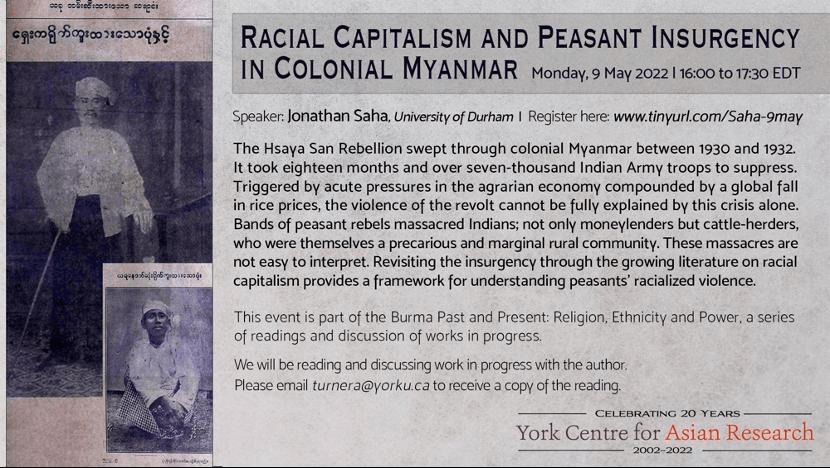
9 May: Jonathan Saha on “Racial Capitalism and Peasant Insurgency in Colonial Myanmar,” 16:00 – 17:30 (EDT). Register here.
Full Title: “Security Settlements in Myanmar’s Borderlands: Legal and Illicit Trades, Wars, and Ceasefires”
Speaker: Dr Adam Burke, The Asia Foundation Date: Thursday 5 May 2022 Timezones: 12.30 – 1.30pm AEST (UTC+10), 9- 10am MMT (UTC+6.30) Zoom: Register here
Given the way that women have been at the forefront of the revolution, and that feminine power has been weaponized in interesting ways in the htamein protests, the intersection of gender and politics is a particularly relevant topic today. With apologies to the many other important texts on gender in Myanmar that we hope to get to at some point, we give you Spiro’s hard-to-find chapter on a village perspective on the danger of women’s sexuality, one we counterpoise with Chie Ikeya’s exploration of P Monin’s progressive (if bourgeois) ideas about sex. We have Tharaphi Than’s book on women in Burma, one that examines a number of interesting political positions held by women across history, including the role of woman soldiers; Jenny Hedström’s more recent work reveals how Kachin women provide emotional, physical, and material labour to support their autonomy efforts. Finally, Chu May Paing argues that Buddhist nationalist desires are mediated through the female body and its reproductive potential. And a bonus: for a related text that features women’s voices in political revolution, see our very first Deep Cuts, here.
We have the results of the BSG election. Please congratulate Htet Lwin (Co-Chair) and Mu Lung Hsu (re-elected as Secretary)!
For the Co-Chairship, it was basically a tie, and Elliott Prasse-Freeman stepped down to allow others to participate and focus on communications (website). We are grateful for Elliott’s service to the BSG over the past three years and appreciate his willingness to continue to provide publication updates.
The BSG hopes to move forward this year with our extant initiatives, which include:
1. Burmese language sources and translation of our website.
2. Selecting and sponsoring a panel for AAS 2023 in Boston.
3. Supporting scholars and students at risk.
4. Enhancing accessibility and inclusivity in Burma Studies.
If you have any ideas for initiatives that the BSG should undertake, please feel free to contact (Tani.Sebro@Humboldt.edu) and Htet Min Lwin (hmlwin@yorku.ca).


 Burma Studies Group