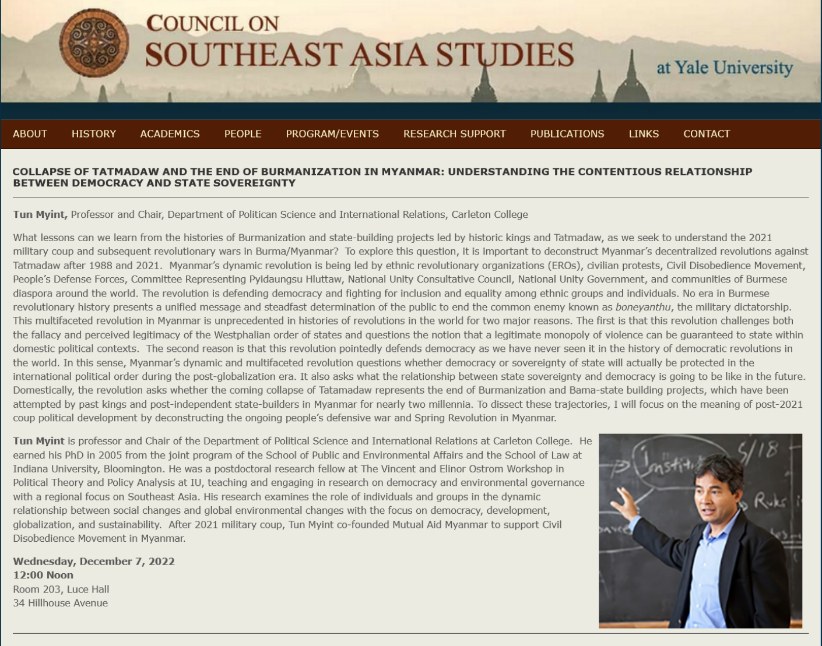
Yale’s CSEAS is hosting Carleton College scholar Tun Myint on 7 Dec 2022, 12pm.
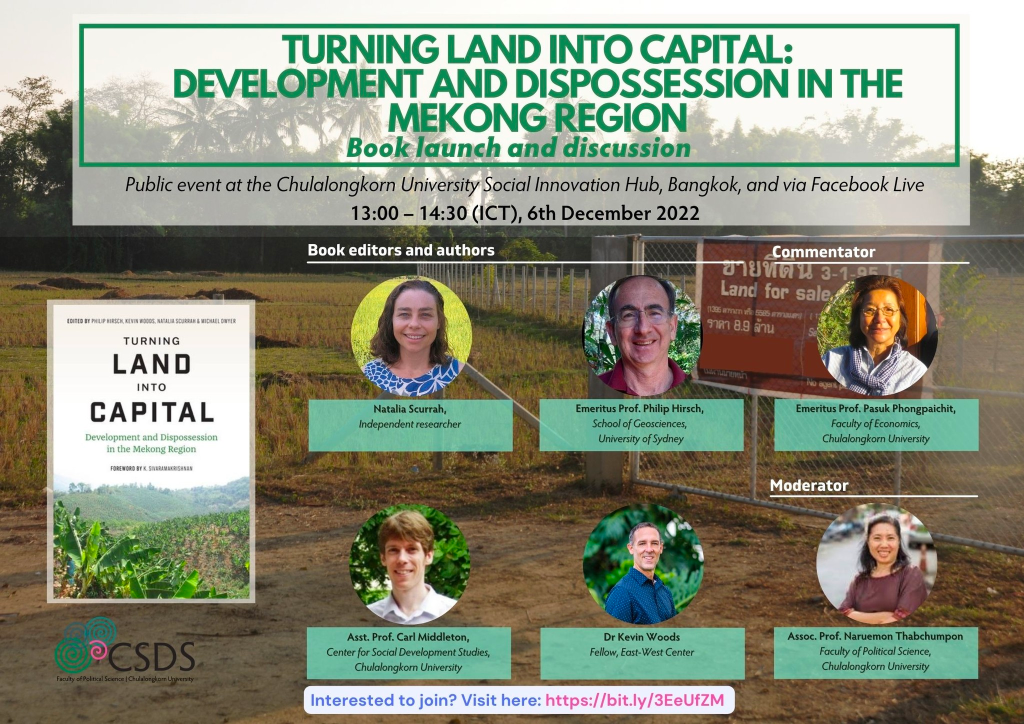
Date / Time: 6 December, 1pm – 2:30pm (ICT)
with Pasuk Phongpaichit; Naruemon Thabchumpon; Philip Hirsch; Kevin Woods; Natalia Scurrah; Carl Middleton
host: Chulalongkorn University’s Social Innovation Hub (Bkk)
zoom / in person registration link.
This week’s New Pubs features a report on the Indo-Burma wetlands; Metro on the how Burmese refugee families deal with US schools; and Hasan et al with an edited volume on humanitarian and legal approaches to the Rohingya crisis.
As ever, see our Recent Publications page for all of the citations and for past weeks.

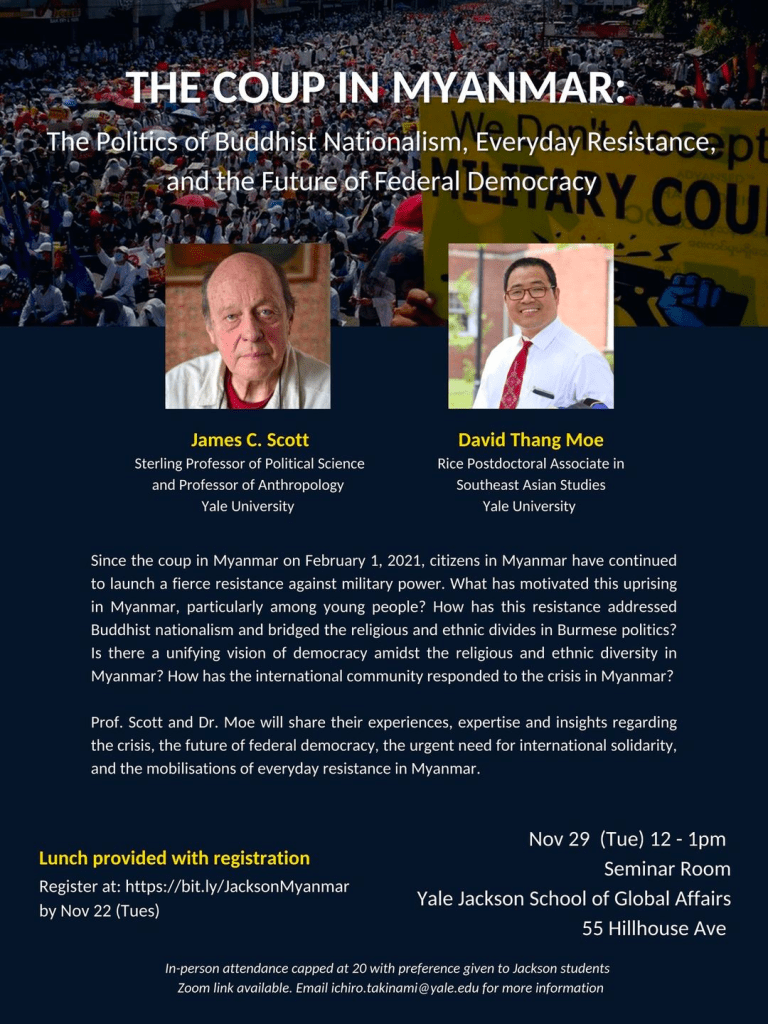
Title: “The Coup in Myanmar: The Politics of Buddhist Nationalism, Everyday Resistance, and the Future of Federal Democracy”
Date / Time: 29 Nov, 12-1pm EST
host: Yale’s Jackson School of Global Affairs
Title: “Defending Human Rights in Myanmar: Responding to the human rights crisis in Myanmar”
panel with Chris Sidoti; Htwe Htwe Thein; Manny Maung; and Tun Aung Shwe
Date / Time: 29 Nov, 6-7pm AEDT
host: Sydney SEA Center
Title: “Local politics and violence in Myanmar’s drylands”
Date / Time: 25 Nov, 7:00 pm – 8:00 pm AEDT
The Anya region remains quite understudied compared to other places in Myanmar. Part of the reason for this lacuna is that long-term fieldwork has been almost impossible since the 1960s. In consequence, we tended to overestimate the homogeneity of Bama society and to see the central drylands as a state space.
Yet, the current guerrilla warfare within Anya contradicts this narrative. I approach this region as an internal frontier of the military state, where people have experienced several episodes of violence and upheaval in recent history. By analysing how violence in the Bama society affects local politics, I seek to specify the experiences of violence, the reconfigurations of temporality, and to understand local politics as changing spaces of engagement.

This week’s New Pubs features Sheikh on a unique project being pursued by Rohingya in Malaysia to create a blockchained archive of their ethnos; Nwet Kay Khine considers factors of resilience and constraint in the Myanmar resistance movement; and Tual Sawn Khai and Asaduzzaman write on on how Covid has affected Burmese migrant workers in Thailand.
As always, see our Recent Publications page for all of the citations and for past weeks.

image courtesy of The Rohingya Project
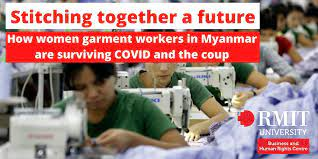
The launch will be online on the 23rd of November at 4pm AEDT with a panel discussion with me, Sara Tödt, co-author of the report, Associate Professor Htwe Htwe Thein from Curtin University and Khain Zar Aung , president of the Industrial Workers’ Federation of Myanmar (IWFM) and treasurer of Confederation of Trade Unions Myanmar (CTUM).
The report is the result of a research partnership between CARE International and RMIT’s Business and Human Rights Centre, and presents interview and survey data on women garment workers during COVID and just after the coup.
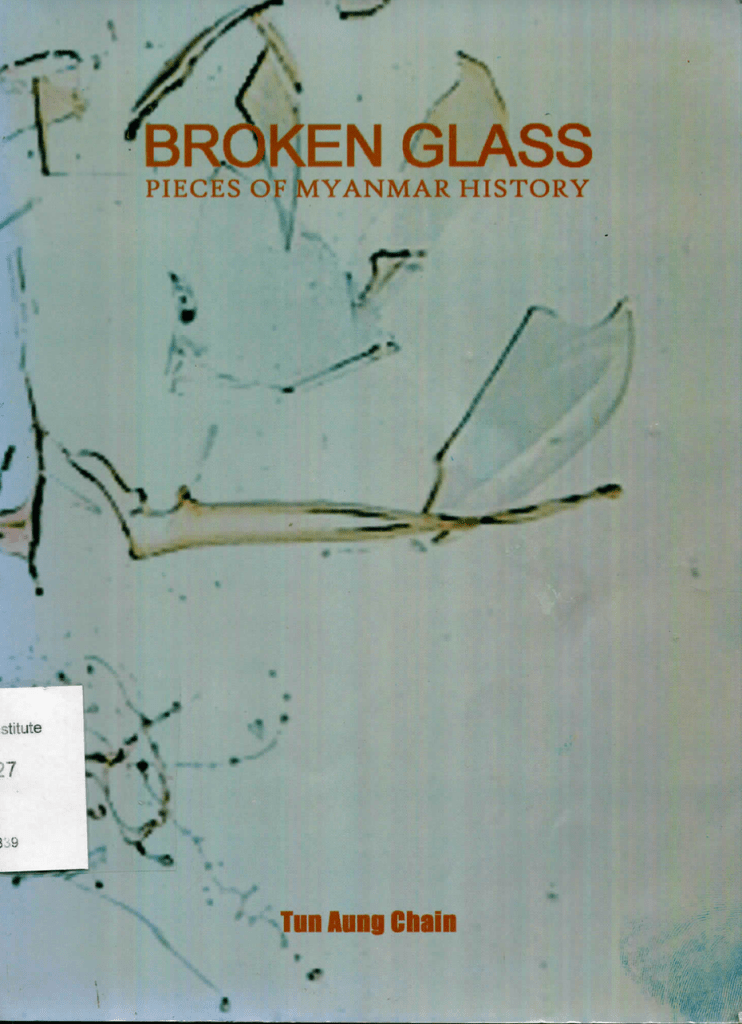
After a six week hiatus, attributable to your stenographer’s busy semester, we return with a Deep Cut that examines historiography written by Burman historians during the post-independence period. Tun Aung Chain concludes by arguing that: “Rather than thinking of nationhood as a process developing in the course of history, [this literature] regarded nationhood as an underlying constant of Myanmar history, innate throughout the political fluctuations of the Bamar kingdoms” (19).
Tun Aung Chain. “Historians and the search for Myanmar nationhood.” in Tun Aung Chain, Broken Glass: Pieces of Myanmar History, SEAMEO Regional Centre for History and Tradition, Yangon, 2004: 9–24.
See here for these pdfs and for all the others in the series.
 Burma Studies Group