Full Title: “Security Settlements in Myanmar’s Borderlands: Legal and Illicit Trades, Wars, and Ceasefires”
Speaker: Dr Adam Burke, The Asia Foundation Date: Thursday 5 May 2022 Timezones: 12.30 – 1.30pm AEST (UTC+10), 9- 10am MMT (UTC+6.30) Zoom: Register here
Given the way that women have been at the forefront of the revolution, and that feminine power has been weaponized in interesting ways in the htamein protests, the intersection of gender and politics is a particularly relevant topic today. With apologies to the many other important texts on gender in Myanmar that we hope to get to at some point, we give you Spiro’s hard-to-find chapter on a village perspective on the danger of women’s sexuality, one we counterpoise with Chie Ikeya’s exploration of P Monin’s progressive (if bourgeois) ideas about sex. We have Tharaphi Than’s book on women in Burma, one that examines a number of interesting political positions held by women across history, including the role of woman soldiers; Jenny Hedström’s more recent work reveals how Kachin women provide emotional, physical, and material labour to support their autonomy efforts. Finally, Chu May Paing argues that Buddhist nationalist desires are mediated through the female body and its reproductive potential. And a bonus: for a related text that features women’s voices in political revolution, see our very first Deep Cuts, here.
We have the results of the BSG election. Please congratulate Htet Lwin (Co-Chair) and Mu Lung Hsu (re-elected as Secretary)!
For the Co-Chairship, it was basically a tie, and Elliott Prasse-Freeman stepped down to allow others to participate and focus on communications (website). We are grateful for Elliott’s service to the BSG over the past three years and appreciate his willingness to continue to provide publication updates.
The BSG hopes to move forward this year with our extant initiatives, which include:
1. Burmese language sources and translation of our website.
2. Selecting and sponsoring a panel for AAS 2023 in Boston.
3. Supporting scholars and students at risk.
4. Enhancing accessibility and inclusivity in Burma Studies.
If you have any ideas for initiatives that the BSG should undertake, please feel free to contact (Tani.Sebro@Humboldt.edu) and Htet Min Lwin (hmlwin@yorku.ca).
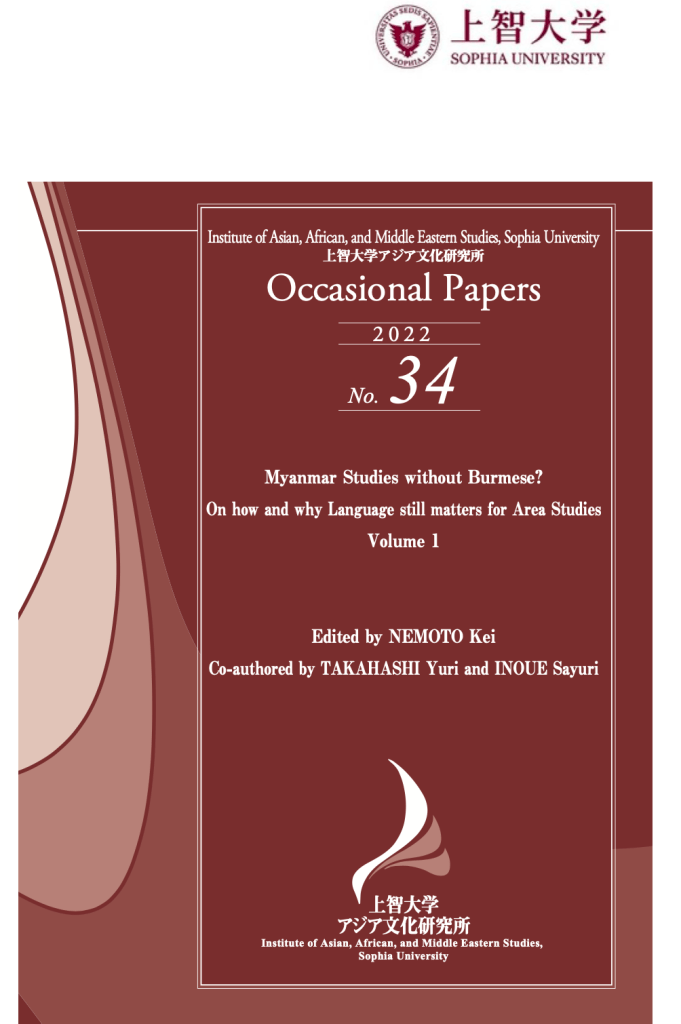
This week we feature Inoue and Takahashi, respectively, in a volume introduced by Kei Nemoto (whose work on DoBama deserves mention in Deep Cuts…); then Kobayashi and King write about the China-Myanmar Economic Corridor; and finally Debnath et al on Rohingya in a geo-strategic perspective. See here for full citations.
This week we feature Benedicte Brac de la Perriere’s wonderful gem of an essay on “Lay Lay,” a pwe-sa (broker) in Yangon. Through an ethnography of Lay Lay’s life, in which she acts as a go-between for various enterprises and schemes, we learn how this ubiquitous but understudied social role functions. In the end, when Lay Lay turns to political activism, we see the similarities between economic and political pwe-sa. (And I can confirm that Lay Lay indeed became a social activist, as I actually met her in my own research on contentious politics in Myanmar!)
Izzy Rhoads likewise explores the pwe-sa in her article in the recent Kyed edited volume (see here for e-book download). Rhoads shows that pwe-sa are not simply market-facilitators, but their significant market experience and superior access to information makes them effective justice brokers as well, in which they serve as “primary arbiter[s] in housing-related dispute settlement[s]” (284).
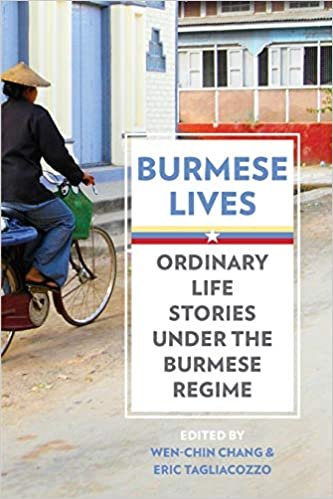
Also, one last quick thing: there are a number of other gorgeous articles in this much ignored volume Burmese Lives in which Brac de la Perriere’s essay lives, so I’ve decided to upload the whole book (minus Boutry’s article, which i couldn’t get to download. See his tribute page as a consolation).

 Burma Studies Group