This week’s New Pubs features van Schendel on Bengali influence in South Asia (including reflections on Rohingya); Goodhand et al on drugs, frontier capitalism, and illicit peasantries in Kachin; and Garnett on ASSK as democracy icon and demagogue.
As ever, see our Recent Publications page for all of the citations and for past weeks, and if anyone wants a PDF but is excluded by pay wall, please email us and we will help if we can.
This week’s New Pubs features Keeler on masculinity and monkhood in Myanmar; Panthamit et al on the role of hundis in facilitating cross-border payments; and Thein‐Lemelson on white shirts as sacred amulets for Burmese activists.
As ever, see our Recent Publications page for all of the citations and for past weeks, and if anyone wants a PDF but is excluded by pay wall, please email us and we will help if we can.
𝐀𝐛𝐬𝐭𝐫𝐚𝐜𝐭: It is widely acknowledged that the armed struggle against the Myanmar military regime is shaped by societal dynamics, including forms of oppression and violence that date back decades. But the reverse is less well-understood: to what extent have experiences of armed conflict shaped Myanmar society? And, acknowledging both the existence of generations-long self-determination struggles and the dramatic rise in armed conflict since the coup, how can Myanmar’s history and future be understood in the light of its diverse geographies of war? Building on ethnographic and geographical approaches to conflict studies, and reflecting on research done with civil society organisations in Karen State before the coup, this talk will discuss the importance of understanding spaces of conflict as diverse but interrelated, even when there appears to be a single enemy ̶ the junta. It will challenge ahistorical accounts of the war in Myanmar, which can privilege dominant actors, and instead foreground how conflicts interact with preexisting socio-ecological relations, and how actors form communities, care for one another, and enact solidarity, even amidst violence. The talk closes by reflecting on the limits of what researchers – particularly those not from Myanmar – can know about everyday experiences of war and violence.
𝗔𝗯𝗼𝘂𝘁 𝘁𝗵𝗲 𝗦𝗽𝗲𝗮𝗸𝗲𝗿: Dr. Shona Loong is a Senior Lecturer at the University of Zurich where she teaches undergraduate and graduate courses in political geography. Dr. Loong studies conflict transformation, peacebuilding, and the politics of international development, and has published extensively on these topics, particularly on Myanmar and its peripheries. Her work has appeared in various geography and social science journals, including Political Geography, Geoforum, and Transactions of the Institute of British Geographers. Dr. Loong is also an editor of the Tea Circle and is a frequent contributor to policy reports on Myanmar.
𝐀𝐛𝐬𝐭𝐫𝐚𝐜𝐭: Surviving the State examines environmental justice, land governance, and state-making from the vantage point of small farmers and grassroots activists struggling for land during Myanmar’s democratic turn. During Myanmar’s attempted political transition in the 2010s, land was the basis not only of smallholder livelihoods and national development, but also a critical domain for negotiating citizenship after half a century of authoritarian violence and racialized exclusion. Turning on its head a rich tradition of scholarship that posits land as a tool for state-making or an outlet for state-escape, I argue that land is key to what I call surviving the state, a set of socioecological practices forged through cultivation and dispossession as well as the gendered work of care and connection. This talk will draw on my book project, based on 26 months of participant observation, over 150 interviews, and five participatory research and art projects, to show how embodied histories of state violence shaped ecologies and communities, ultimately undermining reforms that aimed to formalize property, redistribute land and recognize ethnic territory. In the aftermath of Myanmar’s 2021 military coup, these findings demand reimagining land not just as a resource for survival, but also as a site of revolution and healing.
Hilary Faxon is an assistant professor of environmental social science at the University of Montana, currently on leave as a Marie Skłodowska-Curie Fellow in the Department of Food and Resource Economics at the University of Copenhagen. Her research, teaching and public scholarship investigates environment, development and technology with a focus on social justice in the Global South. She also leads a research project on small farmers and big tech in Myanmar and co-lead two interdisciplinary research groups: one focused on digital transformations in property and development, the other on the ethics and practices of algorithmic conservation.
This week’s New Pubs features a trifecta of feminist Myanmar analysis: Hedstrom et al employing photo-voice to allow female farmers to illustrate their post-coup lives; Frydenlund on Burmese refugees’ labor arrangements in the USA; and Saltsman on the gendered geopolitics of responding to / preventing GBV amongst Burmese displaced in Thailand;
As ever, see our Recent Publications page for all of the citations and for past weeks, and if anyone wants a PDF but is excluded by pay wall, please email us and we will help if we can.
This talk navigates the conceptual waters between two texts: the commentarial works on the Theravāda Abhidhamma by fifth-century philosopher Buddhaghosa, and the musical drama U Shin Gyi, Lord of Brackish Waters by librettist Ko Maung Gyi, which was published in 1905 and is staged to this day by theatrical companies or lay performers on makeshift stages along Myanmar’s littoral coast.
In keeping with the dramatic setting and the eponymous hero of the second text, the talk sets sail in brackish waters, a zone of elemental indistinction where mangrove swamps interlace land and sea and where heterogeneous domains of clean water and turbid water, nature and culture are quite literally fluid. In entangled worlds such as these, where distinctions and categories are not given in advance in the order of things, a basic principle of Abhidhamma thought becomes evident: namely, that it requires tools and techniques of parsing and disentangling—just like a “man standing on the ground and taking up a well-sharpened knife might disentangle a great tangle of bamboos” as Buddhaghosa puts it—to discern and distinguish fundamental entities, categories, and relations. In the musical drama, the tool at hand is not a knife but a musical instrument, the saung gauk (curved harp). Since harps operate quite differently from knifes and since techniques of music making differ sharply from techniques of mindfulness, these procedures each fashion very distinct modes of existence.
This talk takes propositions from Abhidhamma thought, ones that thoroughly destabilize the epistemic frameworks that undergird much scholarship on music and sound, as its point of departure. Close attention to the operational logic of the Burmese harp, however, complicate any simple correspondence between Buddhist thought and musical practice.
Bio: Friedlind Riedel is a researcher at Bauhaus-Universität Weimar working on her monograph “Staging listening: Histories and Techniques of Musical Drama in Myanmar” which is based on longitudinal ethnographic and archival research. She is co-editor of the Oxford Handbook of the Phenomenology of Music Cultures and has published extensively on music and atmosphere. Her current work sits in the midst of Theravada Buddhist thought, media philosophy, (ethno-)musicology and sound studies.
Scholarship on Myanmar, from its colonial history, to its citizenship crises, and the 2021 coup, has heretofore critically interrogated the relationship between ethno-racial identity and socio-political power. However, we have yet to address one important question: what exactly is the difference between ‘ethnicity’ and ‘race’ in the context of Myanmar? This dialogue proposes the utility of reading Burmese history through the analytic lens of critical race theory to identify ethnicity and race as separate, though related, social processes, each with distinct ramifications. This talk will present new research on family law litigation involving mixed Chinese-Burmese Buddhist families in the wake of the ‘British Burma Law’s Act’ (1898-1948) to make the case that racialisation in Burma is drawn along lines of religious rather than ethnic distinction, and that it has historically been drawn along highly gendered lines.
Matthew Venker is a cultural anthropologist studying the historical intersections of race, religion, and citizenship in Burma. His dissertation, Racial Categories, Religious Distinctions: Mixed Buddhists and the Burma Laws Act 1898-1947, interrogates how British colonial structures created new categories of legal personhood that divided the colony’s Buddhist population. He earned his Ph.D. from the University of Wisconsin-Madison in May 2023. He is currently a Visiting Fellow with the Southeast Asia Program, Cornell University.
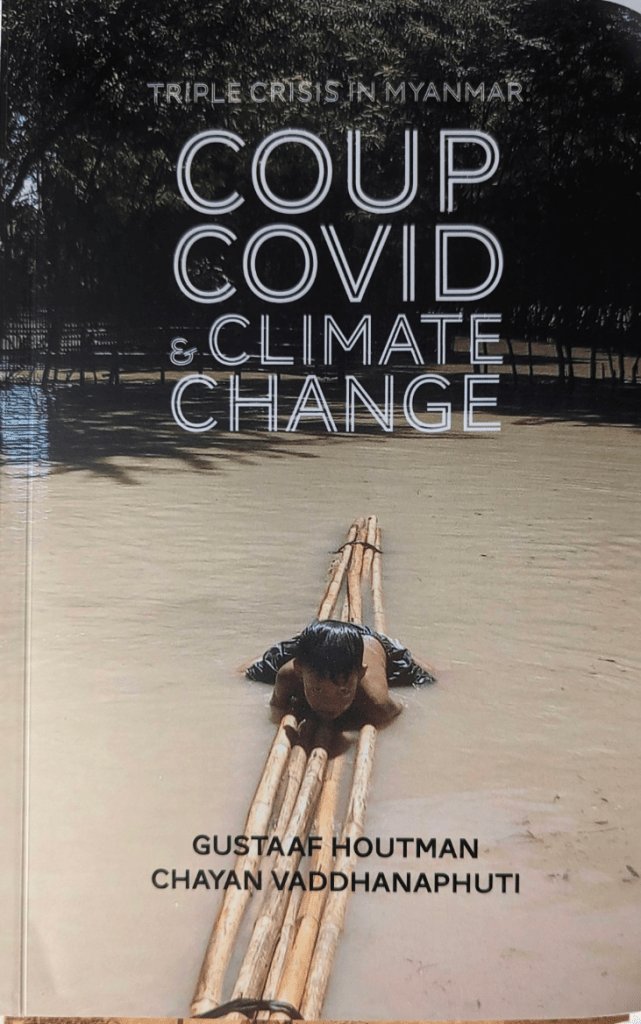
This week’s New Pubs features Houtman and Chayan editing a volume by Myanmar writers on coup, covid, and climate change; Zun Wai Oo and Kawai on the impact of the pandemic and the coup on inclusive education in Burma; and Zahed on the consequences of the 2021 coup for the Rohingya.
As ever, see our Recent Publications page for all of the citations and for past weeks, and if anyone wants a PDF but is excluded by pay wall, please email us and we will help if we can.
WHITE SHIRTS AS SACRED AMULETS: “WORLD-MAKING” AND “SELF-MAKING” DURING THE BURMESE POLITICAL FESTIVAL
Seinenu M. Thein-Lemelson, PhD Anthropology Department, University of California, Los Angeles
Drawing upon Stanley J. Tambiah’s idea of “world conquerors” and “world renouncers,” I examine the Burmese political festival (nainganyei pwe) as a ritual, affective, and material space where former political prisoners reinterpret violence and engage in forms of collective and personal “world-making.” The lecture focuses on one practice in particular: the ritual wearing of white shirts by the 88 Generation. It is argued that there are psychological benefits to donning this symbolic attire. Like sacred amulets described by Tambiah, the white shirt provides ontological security to former political prisoners. For leaders (gaungzaungs) in the movement, the white shirts are integral to how they create and embody power, becoming conduits of charismatic authority. Within the context of the nainganyei pwe and when combined with other “technologies of the self,” the white shirts create a feeling of inviolability and allow survivors of political violence to reassert personal and collective agency. In addition to extending the literature on the sedimentation of power and charisma in objects to contemporary politics in Myanmar, I also attempt to unpack the tensions between precarity versus inviolability and self-making versus selflessness in the “political sacred” space of the nainganyei pwe and the broader cultural system of the Burmese democracy movement.
Seinenu M. Thein-Lemelson, PhD, has been conducting long-term ethnographic and psycho-cultural research in Burma (Myanmar) since 2008. She received her PhD in Developmental Psychology, with a specialty in Culture, Brain, and Development, from the University of California, Los Angeles (UCLA) in 2013. From 2015 to 2016, she was a Templeton-funded postdoctoral researcher at the Institute of Personality and Social Research (IPSR) at the University of California, Berkeley. From 2016 to 2019, she was a Visiting Scholar in the Department of Anthropology at the University of California, Berkeley. Dr. Thein-Lemelson has worked with former political prisoners and democracy activists in Burma since 2013 and is finishing a book-length ethnographic study on the Burmese Democracy Movement. Dr. Thein-Lemelson is also currently a lecturer in the Department of Anthropology, University of California, Los Angeles, where she teaches undergraduate classes on “The Anthropology of Burma/Myanmar,” “Political Imprisonment,” and “Social Movements and Controlling Processes.”
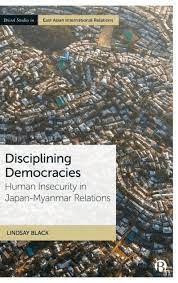
This week’s New Pubs features Black with a book on Japan-Myanmar relations; Lewis on intellectuals in Cold War Burma; and Neef et al on the relationship between conflict, climate change, and displacement for Rohingya in Bangladesh.
As ever, see our Recent Publications page for all of the citations and for past weeks, and if anyone wants a PDF but is excluded by pay wall, please email us and we will help if we can.





 Burma Studies Group