“The US-ASEAN Business Council Institute (USABCI) created the USABCI Myanmar Scholarship Fund to alleviate financial hardships currently confronted by Myanmar students enrolled in accredited US universities due to the current economic crisis in Myanmar. In the 2022-23 pilot year, the Scholarship will provide $5,000 merit scholarships to undergraduate and graduate students from Myanmar enrolled in U.S. higher education institutions. Scholarships may be used to defray academic costs required to achieve a degree, including tuition, fees, books, supplies, and equipment.”
It is unclear how to apply for this based on their website, so I guess stay tuned for more details.
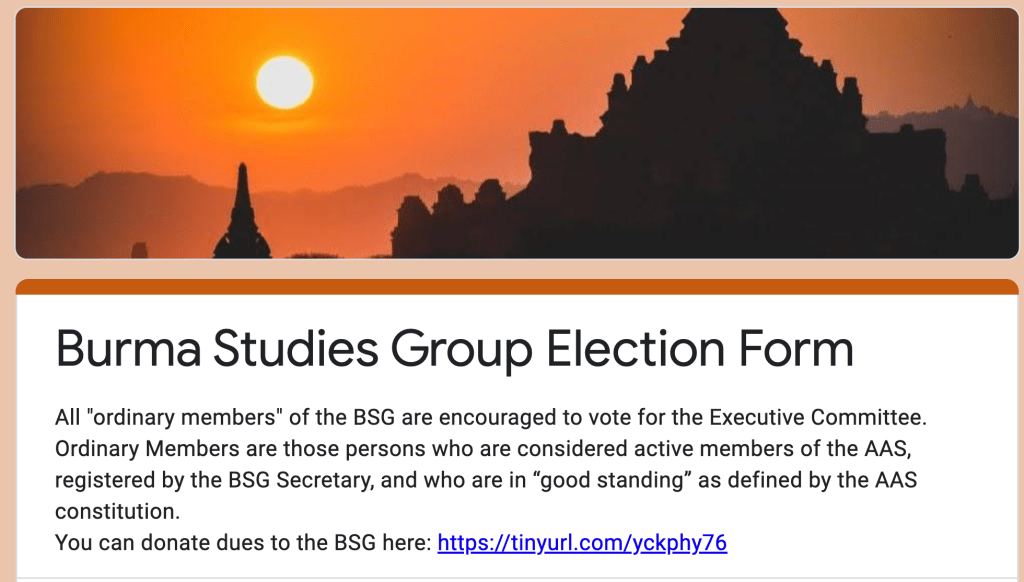
All “ordinary members”* of the BSG are encouraged to vote for the Executive Committee candidates. The open positions are for Co-Chair and Secretary. Cast your ballot here: https://forms.gle/uAsjN4rkhcfrc8qx6
Voting will close on April 22, 2022.
[* Ordinary Members are those persons who are considered active members of the AAS, registered by the BSG Secretary, and who are in “good standing” as defined by the AAS constitution. To vote you need to pay your (very reasonable) annual dues ($20/$10 for students) to the BSG here: https://tinyurl.com/yckphy76 ]
Find below details on this exciting call for papers
_______________
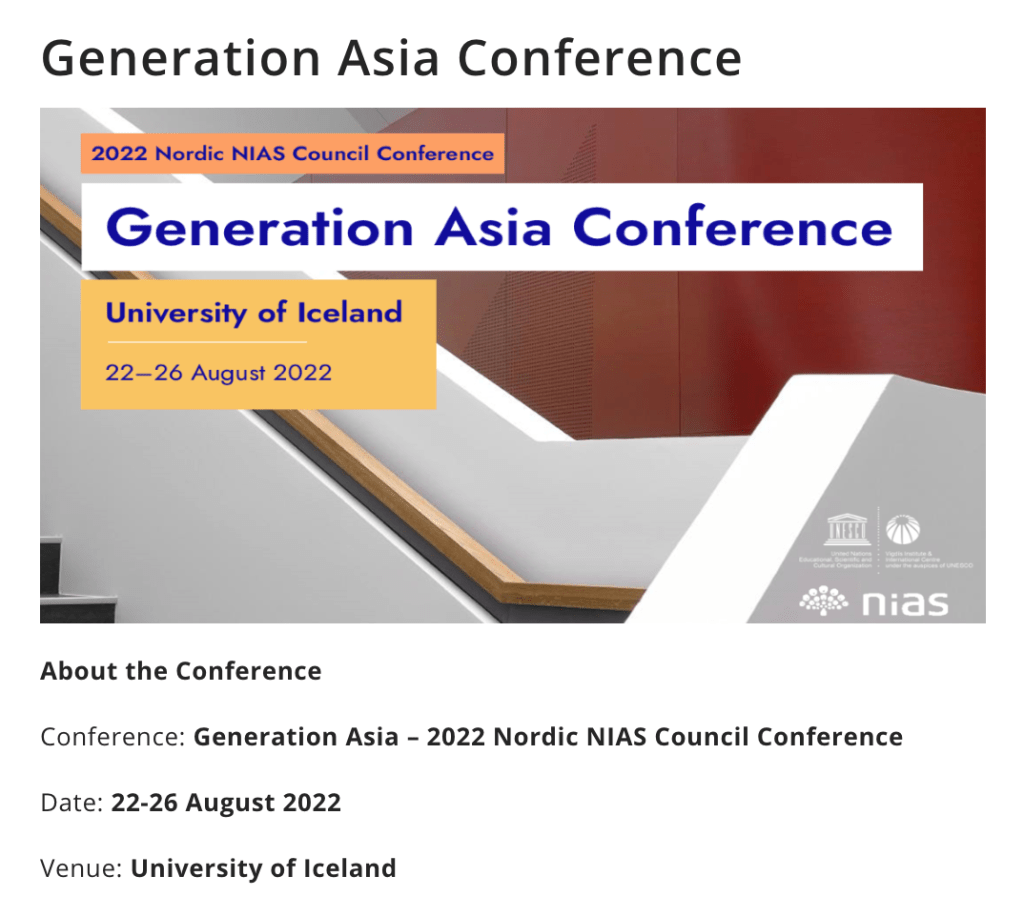
We are inviting paper proposals for our panel titled “Generations of Resistance and Revolution in Myanmar” as part of the 2022 Generation Asia Conference, held at the University of Iceland during 22-24 August 2022. Proposals should include a title and 150 word abstract, as well as your name and affiliation. All proposals should be submitted by 22 April 2022 (Friday) to gen.asia@outlook.com. Please make sure to indicate in your proposal that it is intended for the “Generations of Resistance and Revolution in Myanmar” panel. Below are our panel details. Please contact us if you have any questions. We look forward to your proposals!
Panel Title: Generations of Resistance and Revolution in Myanmar
Organizers: Dr. Terese Gagnon (teresa.gagnon@nias.ku.dk) and Dr. Van Tran (vantran@nias.ku.dk), Nordic Institute of Asian Studies
Abstract: In Myanmar, resistance movements and revolutions have been sustained to an almost unparalleled degree across generations in the 20th and 21st Centuries. Revolutions for ethnic autonomy that began shortly after Burmese Independence and continue to this day are often referred to as among “the longest wars in the world”. Similarly, world-historical anti-authoritarian resistance movements have been transmitted across multiple generations in Myanmar—currently manifested in the Spring Revolution in the wake of the 1 February 2021 coup. These resistance movements and revolutions have been sustained across generations despite considerable shifts in ideology, politics, territory, social norms, technology and more. In this panel we will explore aspects of inter-generational knowledge, affect, and political aspiration that have facilitated the distinct legacies of revolution and resistance in Myanmar. We will also examine sources of friction and sites of silence across generations. Questions discussed in this panel will include, but are not limited to: How has learning occurred across generations of revolution and resistance in Myanmar? What sources of fracture or solidarity have existed across generations? In what ways do events and experiences, rather than strictly time, shape or define generational identity?
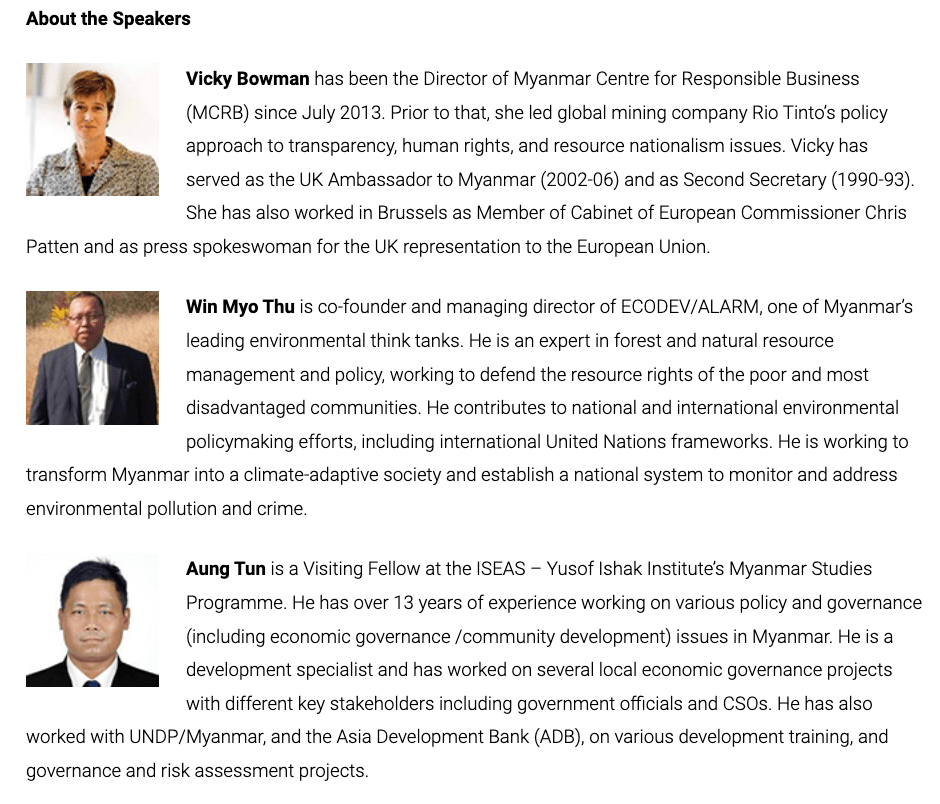
Nang Won Lee, Mae Nam Khone Institute, Myanmar: “Co-creating Knowledge to Enhance Women’s Leadership for Inclusive River Governance and Livelihood Resilience in Inlay Lake, Southern Shan State, Myanmar ”
Saw John Bright, Karen Environmental and Social Action Network (KESAN), Myanmar: “The Salween Peace Park in Myanmar’s shifting political context”
Kyungmee Kim, Researcher, Climate Change and Risk Program, SIPRI Uppsala University, Sweden “Local politics of water: community resistance against dams”
Laur Kiik, Tokyo College, University of Tokyo: “Hydropolitics Meets Ethnopolitics: The Myitsone Dam between Kachins, Bamars, and Chinese”
This week in Deep Cuts we feature discussions of “Burmanization,” with several texts circling around state language policy and its effects. As I put this together I got writing perhaps more than I should have, so rather than subject you all too much editorial input, I will summarize here, and leave my own thoughts below the fold so to speak. Hence, we have: Callahan’s sophisticated description of Burmanization; followed by Kyaw Yin Hliang’s riposte about language policy; then flashing forward to the relative present with Lall and McCormick, respectively, with divergent analyses of the role of Burmese as medium of instruction in ethnic areas today. It finishes with Sai Kheunsai’s short but very sweet personal take on how the sit-tat state’s obtuse prohibitions of Tai language is what turned the author away from being a Bama.
Extended comments:
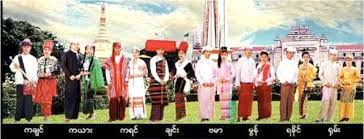
This week in Deep Cuts we feature discussions of “Burmanization,” a term that I personally believe has a vast semantic range and warrants much more exploration. We begin with a debate of sorts between Mary Callahan and Kyaw Yin Hlaing, through respective book chapters from the mid 2000s that are a bit hard to find. Callahan argues that effects of Myanmar state policy enact “Burmanization,” coming up with a sophisticated deployment of a term that most scholars, sadly, just invoke without definition. Burmanization, for Callahan, involves a simultaneous combination of homogenization and differentiation, in which all Myanmar subjects are compelled to conform to a normative unmarked Bama-ness (homogenization) even as taing-yin-tha (TYT) and other non-Bama are collated and categorized (differentiation) as a sort of divide-and-rule strategy.
Kyaw Yin Hlaing’s piece, coming a few years later, seems to respond to such claims, through an examination of the state’s language policy, given that it is often used as an exemplar of Burmanization (particularly through the sit-tat state’s prohibition of mother tongue language instruction in the 1990s and 2000s). While the piece contains unfortunate lines such as “while ethnic minorities were more interested in gaining benefits for themselves and their people than in preserving the Union, the Burman military and political leaders equated their primary duty with the preservation of the Union” (157), KYL does demonstrate that language issues were more complex than they might appear – for one, TYT elites themselves advocated for Burmese as a lingua franca, given that they felt they and their constituents would be even more marginalized by a move to a “neutral” lingua franca such as English; for another, for “smaller ethnic groups” who “outnumbered the dominant ethnic group” in a given area, Burmese was preferred as a language of instruction.
Recent research by Marie Lall buttresses these claims, finding that taing-yin-tha parents often prefer Burmese as the language of instruction to prepare their children for jobs and a life inside Burmese-language-dominated spaces. Patrick McCormick concurs, to some extent, but also finds that for taing-yin-tha whose lives are not oriented towards the Bama heartland, Burmese language is actually less relevant (and here we recall Boutry’s point about non-Bama spaces from a fortnight ago). Juxtaposing these research findings serves to remind us that Burma is not a place where space is governed in a homogenous way, casting a question on whether “Burmanization” (as a totalizing concept) is appropriate for describing such a state, and (if I may be so bold) compelling a research agenda that explores where, when, for whom, and with what intensities and effects (and affects!) does something like “Burmanization” (or related cognates) operate. Hopefully such a focus will allow us to alter our representational practices a bit, going from describing an individual simply as “a Bamar” or “a Kachin” or “a Rohingya”, for instance, to include information about class, gender, language, and location as well – as these may be more predictive of patterns of discrimination and oppression than the ethnic label (indeed, poor Bama – from the Delta, Anya, or Dawei, let’s say – who feel discriminated against as တောသား for their non-normative accents and non-standard cultural practices describe discrimination that feels functionally pretty similar to many forms of discrimination described by ethnic nationals).
Finally, along these lines, I want to include my own personal favorite in the Burmanization debates, a short piece by Sai Kheunsai, entitled “How I Became Shan,” which in a few short pages destabilizes many common presumptions about Burmanization (that it is a project realized and effected, rather than one that fails, and in that failure produces unpredictable effects – perhaps the opposite of what it might seem to seek: resistance to Bama identity and identification with TYT ones). He concludes with a question: “I have never stopped wondering: Had successive Burmese governments been as enlightened and magnanimous with the upkeep of Shan literature and culture… would I still choose to be Shan?”
In lieu of Recent Publications this week (there were none that I saw!), I wanted to convey an initiative being suggested by some American librarians and taken up by friend-of-the-BSG and U Michigan grad candidate Matt Schissler. He has written the explanatory note below.
We are recruiting an ad-hoc committee for those who would be interested in helping contribute to this important initiative. We will likely draft a BSG letter endorsing the initiative and also try to recruit other academic institutions and Burmese intellectuals to sign as well. If you are interested please email soceep@nus.edu.sg.
______
Note from Matt Schissler: I think we now have a real shot at getting materials catalogued in Burmese script and scripts for other ethnic languages, for a few reasons. This should happen, for a few reasons. There is something practical that a collective of Burmese-speaking scholars can do to help make it so. Also, there is a separate initiative to change the Romanization system currently in use, which has pros and cons that need to be factored in.
Background:
I recently joined two meetings of the Committee on Research Materials on Southeast Asia (CORMOSEA), the group which coordinates work by libraries holding SEA materials in the US: their “Collection Development Annual Meeting” and then the meeting of the Technical Processes (“Tech Pro”) subcommittee. One of my goals was to bring up the issue of how Burmese language materials are catalogued.
The problem:
The basic point I made was to raise concerns about the continued practice of cataloguing only using English romanization for materials from Myanmar.
First, Romanization makes it hard to find materials held in US libraries. One has to learn the romanization system, which is not intuitive, and not necessarily the same as the various other systems in circulation. One result is that materials held in US libraries are probably under-utilized. I wonder if this may also have consequences for how budgets are allocated to acquire and maintain materials from Myanmar.
Second, this is a moral issue. Materials in Burmese and other languages from Myanmar are not only for scholars who can take the time to learn the multiple romanization systems. They are also for people who identify with those languages. Those folks should not have to learn what amounts to two more languages—English and the romanization—in order to find materials written in Burmese, Mon, Shan, etc. Cataloguing in English locks things away in a walled garden, and there are inequities in who can scale those walls. It’s worth noting that things are done differently for materials from many other languages that use other writing systems, including Chinese, Korean, and Japanese.
Why is it important to take this up right now?
First, it is technologically feasible. NIU began cataloguing in Burmese in Sep 2021 and has already added Burmese script to at least 3,700 records. Harvard has also tested logging in Mon, Shan, Pa’O, and Sgaw. Obviously the National Library in Myanmar is cataloguing in Burmese. This can be searched online. Old difficulties (Zawgyi…) may be behind us. And there are also hints at the potential capability to automate some of the process, such that if materials are catalogued in Burmese script, a romanization can be generated for a parallel entry. We should always be cautious of techno-fixes. But I have heard that Arabic and Slavic language library communities have had luck with this. Apparently, the British Library is also working on something similar for Burmese. This general Script Converter has Burmese also, though not for the Library of Congress romanization style (see http://aksharamukha.appspot.com/converter).
Second, right now may be fortuitous convergence of interests. CORMOSEA appears receptive. Recent experiences with COVID-related library closures have also given things a kick, highlighting just how inadequate the romanized catalogues are when one cannot browse the stacks in person. The NIU representative at CORMOSEA shared that this was a key reason they started adding Burmese entries. Many libraries are also now attempting their own “Diversity, Equity, and Inclusion” initiatives (for example: https://www.lib.washington.edu/about/edi/critical-cataloging-and-archival-description). I think cataloguing only in English is clearly a DEI issue.
Finally, there is another effort underway that needs to be considered carefully. This is a proposal to modify the romanization system that the Library of Congress uses, which I believe was originally developed by Saya Okell. Virginia Shih, the SEA librarian at the UC Berkeley library, has been working on this with help from SOAS and the British Library. An online survey has been circulated about the issue (which I missed—did others see it?), and a proposal for revisions to the romanization table has been developed, though I believe it is not 100% finalized yet. My understanding is that the intention is to approach the Library of Congress and ask them to adopt the new modified system. However, in the CORMOSEA TechPro meeting that I joined, once the discussion of logging materials in Burmese script began, there was then a debate over whether it is a good idea to push for changes to the romanization system while *also pushing for parallel logging in Burmese. Both changes entail their own labor and resources. Concerns were also expressed that yet another romanization system would compound confusion while not solving the underlying problem.
What can BSG do?
Cataloguing in Burmese and other ethnic languages will take time and labor and that costs money. One concern that was raised with me is that most libraries don’t have staff who can type in Myanmar etc. It would be a large undertaking, particularly if one factors in parallel logging both for new material and also everything already catalogued. But libraries have successfully grouped together to address similar problems, with other non-English materials cataloged only in English. Funds can also be raised.
I’d be interested in putting our heads together on how to help with the above. But in the short term, a clear request came from the CORMOSEA “TechPro” subcommittee meeting: can Burma Studies scholars weigh in? I was told that a letter calling for cataloguing in Burmese, from a collective of Burmese-speaking scholars, would be helpful. I got the sense it could come from the BSG, or if not the BSG officially then it could come in the form of a letter that gathers individual signatures. I understand that one key actor in all this that they would need to engage is the Library of Congress, and I was told that a public letter taking a stance on this issue would be particularly helpful for that.
Is this something that the BSG can take up? If so, please include me in whatever modality that takes shape. If not, I’ll just put myself out there and say, if anyone else is interested, let’s get together and work on this.
Finally, however this is taken forward—either within the BSG or separately—it sounds like a clear decision needs to be made: we can call for cataloguing in Burmese and ethnic languages—or we can call for that plus also call for changes to the romanization system. Right now, my personal opinion is that I agree with some of the others in CORMOSEA: we should focus energy primarily on the former, getting materials logged in script. The current romanization system is imperfect, but if forced to choose, I’d prefer materials logged in Burmese/ethnic languages + imperfect romanization, over materials logged only in (a newly imperfect) romanization… But I don’t know the extent to which it is truly a forced choice.
I freely acknowledge my lack of expertise in all this. I could be radically misunderstanding the limits to what is possible and the convergence of interests. But there are ongoing conversations about decolonizing universities, disciplines, and area studies communities like this one. It might seem small and not all that exciting, but I think library catalogues are a front worth opening…



 Burma Studies Group