Deep Cuts #19 – Tattooing and the Body

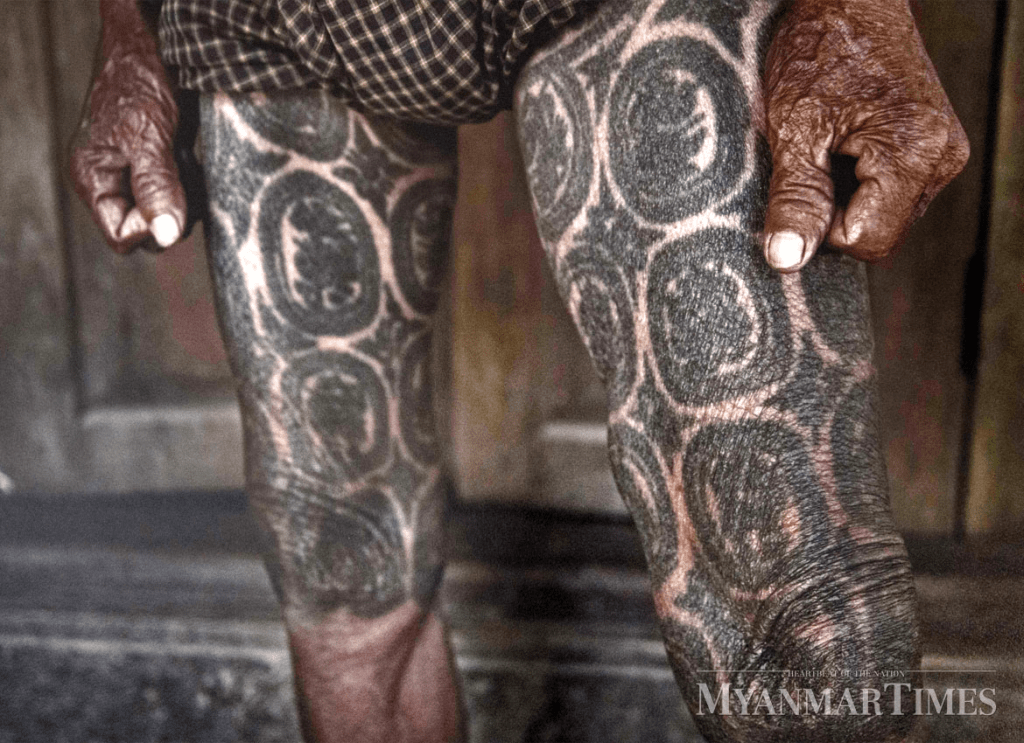
The body in Burma is an understudied object (we introduced some discussions of it in DC #15). One of the ways to get at it is through the way it is adorned and how that connects with theories of apotropaic power. We include this week Tannenbaum’s classic on Shan (Tai) tattooing practices and how they relate to protection / enhancement of the body. Students of weikza ဝိ္ဇ္ဇာ, the Burmese wizard with supernatural powers, also explore the uses of the body in fascinating ways – give you Patton’s exploration of the way ingestion of sacred diagrams enhances potency, and Coderey’s ethnography of weikza healing practices in Arakan.

see here for this week’s PDFS and for all the juicy cuts.

(photo from article on Tai tattooing here)

Future Pubs: “Winning by Process,” Cornell U Press, 2022.

Bertrand, Jacques, Alexandre Pelletier, and Ardeth Maung Thawnghmung. Winning by Process: The State and Neutralization of Ethnic Minorities in Myanmar. Cornell University Press, 2022.

Winning by Process asks why the peace process stalled in the decade from 2011 to 2021 despite a liberalizing regime, a national ceasefire agreement, and a multilateral peace dialogue between the state and ethnic minorities. Winning by Process argues that stalled conflicts are more than pauses or stalemates. "Winning by process," as opposed to winning by war or agreement, represents the state's ability to gain advantage by manipulating the rules of negotiation, bargaining process, and sites of power and resources. In Myanmar, five such strategies allowed the state to gain through process: locking in, sequencing, layering, outflanking, and outgunning. The Myanmar case shows how process can shift the balance of power in negotiations intended to bring an end to civil war. During the last decade, the Myanmar state and military controlled the process, neutralized ethnic minority groups, and continued to impose their vision of a centralized state even as they appeared to support federalism.

See all of our future pubs here.

Deep Cuts #18 – Burmanization (2 of ?): Holmes and Houtman

Where did “Burmanization,” as a term, come from? We think the first mention is in a 1967 article by Robert Holmes entitled “Burmese domestic policy: the politics of Burmanization.” But there the author took “Burmanization“ to mean the cleansing of specific ”foreign“ elements (Western, Chinese, and Indian capitalist) from the country after the 1962 military coup. In other words, “Burmanization“ was not used as a way to differentiate Bama from taingyintha, at least in this specific text.

Houtman’s might be the first published use. Although his contribution, to be fair, is not explicitly on Burmanization but on Myanmafication. And this is not just a semantic quibble – for his use of “Myanmafication” focuses on the SPDC’s attempt to create a new quasi-civil identity under the sign “Myanmar” (all while smuggling in Bama normativity). His towering book is not just on these issues, however, and must be engaged by all serious Burma Studies students for the arguments about mental culture and its relationship to politics – which is why we link to it here, with all the other cuts.

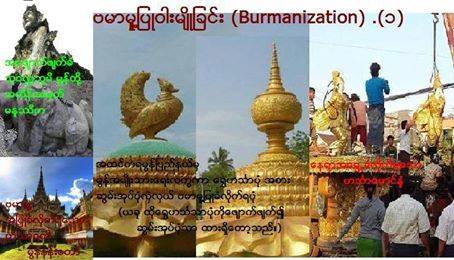
Burmanization: lumyo-gyi wada or pyu-chin?