Deep Cuts #31 “Transethnicity” in Burma by Robinne and Sadan

François Robinne and Mandy Sadan, co-editors of a 2007 volume reappraising Edmund Leach’s Burma work, have a concluding essay that applies the concept of ‘transethnicity’ to Myanmar. They use the concept to destabilize the analytical primacy of the ethnolinguistic group through a pincer move wrought by two different scalar reorientations. First, they consider the broader social systems in which many ethnic groups interact (“transethnicity may refer to a somewhat arbitrarily defined area in which a social system exists, whatever may be the ethnic diversity of that area” (300), a reorientation which also allows them to get “below” the ethnic group to stress that often the relationships that matter “are not between ethnolinguistic subgroups, but between villagers and partners, whose exchanges and networks contribute to the establishment of social cohesion, albeit an unstable cohesion, in a multi-ethnic landscape” (304).

And it’s only 11pp long, with a map!

Robinne, François and Mandy Sadan, “Postscript: Reconsidering the dynamics of ethnicity through Foucault’s concept of ‘spaces of dispersion’” in Robinne and Sadan eds Social dynamics in the highlands of Southeast Asia: Reconsidering political systems of highland Burma by ER Leach. Brill, 2007.

See here for the PDF, and for all the other cuts.

Event: Soldier Defections by Helene Maria Kyed

click here to register

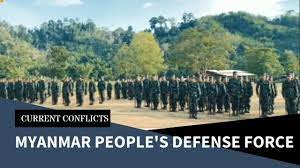
Since Myanmar’s military leaders staged a coup on 1 February 2021, an estimated 10,000 soldiers and police officers have defected by joining the ‘people’s side’ in opposing military rule. These defectors refuse to be complicit in the violent crackdowns and killings of civilians by the military. Arguably, the number of defectors is low compared to the estimated 300-350,000 strong Myanmar military, and so far, there are no signs that the defections have changed the military leaders’ course of action. Nonetheless, defections constitute a significant symbolic blow to the military’s internal coherence and legitimacy. Also, the degree to which defectors have organised themselves and aligned with the anti-coup, pro-democracy opposition to the military is unprecedented in Myanmar’s long history of military rule. Based on online sources, interviews and historical analysis of the Myanmar military, this presentation discusses the motivations behind as well as the obstacles to defections.

About the speaker: Helene Maria Kyed, senior researcher and research unit leader, DIIS, Copenhagen. Anthropologist by training, Helene Maria Kyed has done research on security and justice related issues in Mozambique, Swaziland, and Myanmar, focusing on theoretical questions of violence, sovereignty and legal pluralism.

Opportunity: Chevening Fellowship for Shan language materials

The Shan Collections Fellowship is aimed at individuals from Cambodia, China, Laos, Malaysia, Myanmar, and Thailand.

This fellowship will be hosted by the Asian and African Collections department. The British Library holds about 3000 manuscripts from Southeast Asia, forming the largest and most significant collection of Southeast Asian manuscripts in the UK. Of these, approximately 100 manuscripts, divided between the Burmese and Thai collections, are written in Shan language and script, spanning from the 18th–19th centuries, and including some of the highlights of these collections. The Library also holds ca. 100 print publications in Shan, including early printed books from the 19th century. This Chevening British Library Fellowship is an opportunity to work closely with curatorial staff in the Library’s Southeast Asia Collections on cataloguing and researching Shan language manuscripts and print publications.

more information here.

Action: Write to support Burmese language scholarship at SOAS!

please see the letter from Professor Justin Watkins about the imminent termination of Burmese at SOAS, and please write to SOAS here:

Dear Colleagues and friends in Burma Studies –

With concern and sadness I’m sharing the news that the post of Professor of Burmese at SOAS, University of London, has been scheduled for termination and, if things go as SOAS plans, more than a century of scholarship and research in the lanɡuaɡes and linɡuistics of Myanmar and mainland SEAsia will draw to an end in just over a month. Some very limited Burmese language teaching may continue for now, but not by me, even after 23 years of service. It is some comfort that dear ဆရာကြီး John Okell is not alive to see his legacy being dismantled.

It’s not clear why the Professor of Burmese post has been selected for removal, now that SOAS is under new leadership and recovering well from the financial meltdown of 2020. It seems particularly at odds with the ethos of SOAS to be cutting UK scholarship in Burmese at a time when Myanmar is in such an awful position, and also at odds with the founding charter of SOAS “to accept a special commitment to language scholarship relating to Asia, Africa and the Middle East.”

I call upon colleagues, former students and all those who would wish SOAS to reverse this decision to write to the Director or Deputy Director of SOAS in the most persuasive and supportive way you can, making the case for keeping the Professor of Burmese post. Do share this news with others who may wish to voice support, and feel free to email me privately for further information if you would like.

လေးစားလျက်

Justin Watkins
Professor of Burmese
SOAS, University of London

Event: “What’s next for Myanmar’s Rohingya?” FCCT (and online), 25 August

After a fairly long “summer” / monsoon hiatus, we have an event to promote! The Foreign Correspondence Club of Thailand will be hosting the following people to discuss the future for the Rohingya community in Myanmar.

Details: 7pm (Thai time), 25 August 2022, livestreamed on the FCCT Facebook page (https://www.facebook.com/FCCThailand). more info: https://www.fccthai.com/events/115

Aung Kyaw Moe, advisor on Rohingya issues, National Unity Government of Myanmar, Ministry of Human Right

Shahidul Haque, Former Bangladesh foreign secretary and Bangabandhu Chair at Delhi University, India

Laetitia van den Assum, former Netherlands ambassador and member of Kofi Annan’s Advisory Commission on Rakhine State (2016-17)

Chutima Sidasathian, a journalist specializing in human trafficking issues

Kingsley Abbott, director of global accountability and international justice, International Commission of Jurists and former senior legal advisor at the Khmer Rouge Tribunal.

Moderator – Gwen Robinson, past president of the FCCT 

see here for our full calendar of events.

Deep Cuts #30 – Sarkisyanz’s classic on Burmese Buddhist Biopolitics

Sarkisyanz traces the long history of “the royal ideal of a welfare state” (56) in Burma, from Ashokan influences, through Kyanzittha’s proclamations that “‘all the people … shall eat plenty of food, … shall enjoy happiness'” (50), to Mindon, who “refused to arm his forces with modern weapons in order not to be responsible for the destruction of life” (97). This lineage culminates, in Sark’s narrative, with the syncretic Marxist Thakins, but even more so in Nu, who eliminated the death penalty (221) and was seen by monks interviewed in 1959 as the “closest approximation to the ideal of the perfect Buddhist ruler in the Ashokan tradition” (226). Ultimately, Sarkisyanz attempts to adduce in this tradition an “aspiration to base the state on an ethical maximum” (236), although he does at least admit that the Ashokan ideal must contend with other models of kingship: “Against the background of ruthless power practices of numerous historic monarchs, the Bodhisattva ideal of kingship proved only a partial ideational foundation for the royal charisma” (80). Indeed, as a BSPP ideologue gloated after the 1962 coup, “U Nu’s government did not know ‘what it means to care for the people, far less capable of carrying out what little it knew …’  It was elected by a majority of the people. But: ‘Sometimes what a man desires to have is not what he actually needs … It happens that what a man desires is actually dangerous for him and for society. So also with nations …’” (234). The BSPP and the SPDC after it would endorse a form of “tough love” that would re-center the ruthless power imperatives of rule. Nu, it would appear, was just too soft (နု)…

Sarkisyanz, Emanuel. Buddhist Backgrounds of the Burmese Revolution, Springer, 1965.

See here for the PDF, and for all the other cuts.

Opportunity: 2023 ANU Humanities Research Centre Visiting Fellowship

Applications are now open for the 2023 ANU Humanities Research Centre Visiting Fellowship program. About the fellowship program:


• Provides travel and accommodation for up to 3 months at the Australian National University (for numerous scholars each year)
• Applications welcome from eligible scholars working in every discipline and from every part of the world who wish to contribute to 2023 annual theme of “Repair” (described below)
• Applications close 30 September 2022
• Guidelines, application form and eligibility: https://hrc.cass.anu.edu.au/news/hrc-2023-visiting-fellows-scheme-now-open
• Queries to admin.HAL@anu.edu.au