April 2025 (5): Special Issue on “Weaknesses of the Sit-tat,” with Tun Myint, Yucca Wai & Joseph Andersson, Chan Min, Aung Myo Htet, Yay Keh, Htun Zaw Myat, Htet Myat, Thet Paing, Naung Yoe, Maw Kun, and Ma Su Thit.

April 2025 (5): Special Issue on “Weaknesses of the Sit-tat,” with Tun Myint, Yucca Wai & Joseph Andersson, Chan Min, Aung Myo Htet, Yay Keh, Htun Zaw Myat, Htet Myat, Thet Paing, Naung Yoe, Maw Kun, and Ma Su Thit.

| MRC Dialogue Series 2025 |
| Cross-border infrastructures enabling scamming operations along the Thai–Myanmar border Date: Tuesday 9 September 2025 Time zone: 5.30–6.30pm AEST, 2-3pm MMT, 9.30-10.30am CEST Zoom link here |
The rapid expansion of cyber-scamming operations along the Thai–Myanmar border, particularly in Myawaddy and Shwe Kokko, underscores the role of conflict-affected borderlands in facilitating illicit economies. Rooted in decades of ceasefire capitalism and exacerbated by Myanmar’s post-coup instability, these scam hubs operate within a complex governance framework involving state, non-state, civilian and armed actors. This study examines the infrastructure that has enabled these operations to proliferate, focusing on three key dimensions: the establishment of trade border zones and channels that provide a foundation for informal and illicit activities, the labour and goods market dynamics that sustain the scam industry, and the financial and legal mechanisms that enable large-scale money laundering and law evasion.
By mapping the physical, political, and digital networks that support these activities, this research highlights how border zones can function as enabling environments for organised crime. Extensive field research, interviews, open-source intelligence, and expert analysis are synthesised with the aim of providing a comprehensive understanding of how cyber-scamming operations are structured, financed, and maintained. What follows is an exploration of how local communities and transnational actors contribute to, benefit from but are also impacted and limited by these operations. The findings offer crucial insights for policymakers seeking to disrupt these networks, regulate border economies, and address the socio-economic vulnerabilities that drive participation in illicit industries.
Speaker
Laure Siegel has been working since 2014 in South and Southeast Asia as an independent journalist, researcher and media trainer. She graduated from the Strasbourg University of Journalism at the French-German border. She is a member of Alter-Sea (Observatory for Political Alternatives in Southeast Asia) as well as the ASEAN-China-Norms network led by CNRS (French National Center for Scientific Research). She specialises in Thailand and Myanmar political and social landscapes and regularly produces research reports, exhibitions and documentaries on those issues. She founded a storytelling academy for Burmese youth in the aftermath of the 2021 coup.

This week’s New Pubs features Salem-Gervais on local language education amidst conflict and federal aspirations in Myanmar; Aye Lei Tun and Ardeth Thawnghmung with the Myanmar entry in the Routledge Handbook of Autocratization in Southeast Asia; and Moni et al analyzing the proposal of a humanitarian corridor to Rakhine state.
See our Recent Publications page for all of the citations and for past weeks, and if anyone wants a PDF but is excluded by pay wall, please email us and we will help if we can.

Sources: MIMU, SIL, LSDO.
This week’s New Pubs features Buscemi’s book on weapons in Myanmar’s borderlands; Bächtold on Facebook’s work in Myanmar as imperial experimentation; and Faxon on militarization and refugee networks along the India / Burma border.
See our Recent Publications page for all of the citations and for past weeks, and if anyone wants a PDF but is excluded by pay wall, please email us and we will help if we can.

A new special issue of JoBS, “Histories of Belonging and Identities (Re)Imagined,” edited by Hitomi Fujimura and Alicia Turner (29.1), is out!
It has contributions from Maynadi Kyaw on the Japanese and U Ottama; Kazuto Ikeda on Karen and the Thakins; Fujimora on booze and gender; and Kei Nemoto on shoes and religion.

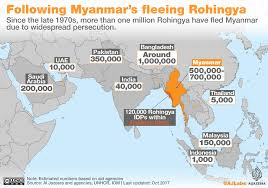
This week’s New Pubs features Hue on Burmese art (and life) in diaspora; Islam on calling the Rohingya “kalar”; and Han and Khemanitthathai on security cooperation among Myanmar and Thailand.
See our Recent Publications page for all of the citations and for past weeks, and if anyone wants a PDF but is excluded by pay wall, please email us and we will help if we can.

This week’s New Pubs features Frydenlund rethinking surplus populations via Rohingya in KL; Ye Phone Kyaw on which name, Myanmar or Burma, best represents indigenous linguistic practices; and Courtin et al find associational evidence in Burma linking poverty to anti-Muslim prejudice.
See our Recent Publications page for all of the citations and for past weeks, and if anyone wants a PDF but is excluded by pay wall, please email us and we will help if we can.

source: internet
Crouch, Melissa. The Palimpsest Constitution The Social Life of Constitutions in Myanmar. Oxford University Press, 2025.
Since the mid-20th century, many former postcolonial states have engaged in multiple constitution-making exercises, with the turnover in written constitutions often due to coups or internal conflict. Conversely, people have resisted authoritarian rule through alternative constitution-making. The reality that most countries have had numerous official and unofficial constitutional texts begs the question: How do past constitutions matter in the present? This volume explores the social life of constitutions, or how past constitutions matter. Using the case of Myanmar, Crouch demonstrates that constitutions are a palimpsest of past texts, ideas, and practices, an accumulation of contested legacies. Through constitutional ethnography, she traces Myanmar’s modern constitutional history from the late colonial era through its postcolonial, socialist, and military regimes. The Palimpsest Constitution captures the idea that contemporary debates about constitutional reform are informed by the contested legacies of the past. Today, the military insists on the endurance of its 2008 Constitution while pro-civilian actors resist military rule through alternative constitution-making endeavours. Offering a sociological view of constitutional endurance, the book demonstrates how the social life of contested constitutional legacies are central to the struggle for constitutional democracy and civilian rule in Myanmar.

This week’s New Pubs features Rhoads on how displacement is impacting Myanmar citizenship; Lynn Thar Yar and Jefferson on lawyering under post-coup Myanmar’s authoritarian regime; and Hedström’s book Reproducing Revolution, on the Kachin struggle, is out and open access.
See our Recent Publications page for all of the citations and for past weeks, and if anyone wants a PDF but is excluded by pay wall, please email us and we will help if we can.

see here for more information about a one-year Postdoctoral Fellowship for a Myanmar researcher at the ANU: https://jobs.anu.edu.au/jobs/postdoctoral-fellow-canberra-act-act-australia-68d78b43-f03f-4fd9-b66e-a78b084e59c9

The position is funded by the Department of Foreign Affairs and Trade, Australian Government, as part of the “Advancing Research and Dialogue on Political, Social and Economic Conditions in Myanmar” project, through the Myanmar Research Centre. The position is based in the Coral Bell School of Asia Pacific Affairs, ANU College of Asia and the Pacific.
This is a research-only postdoc. There are no teaching responsibilities. It will run, subject to visa approval process, for the calendar year of 2026. There is some flexibility on the starting month.
To be eligible, you must be a Myanmar national who has completed a PhD within the last five years on the political, social or economic conditions of present-day Myanmar, in any discipline. Applicants who have not previously held a postdoctoral position will be preferred.
If you have any questions about the position that are not answered through the information on the website and in the application form then you can direct them to me at my ANU email address.