upcoming event: Riedel on how Abhidhamma thought destabilizes music/sound scholarship (27 Sept)

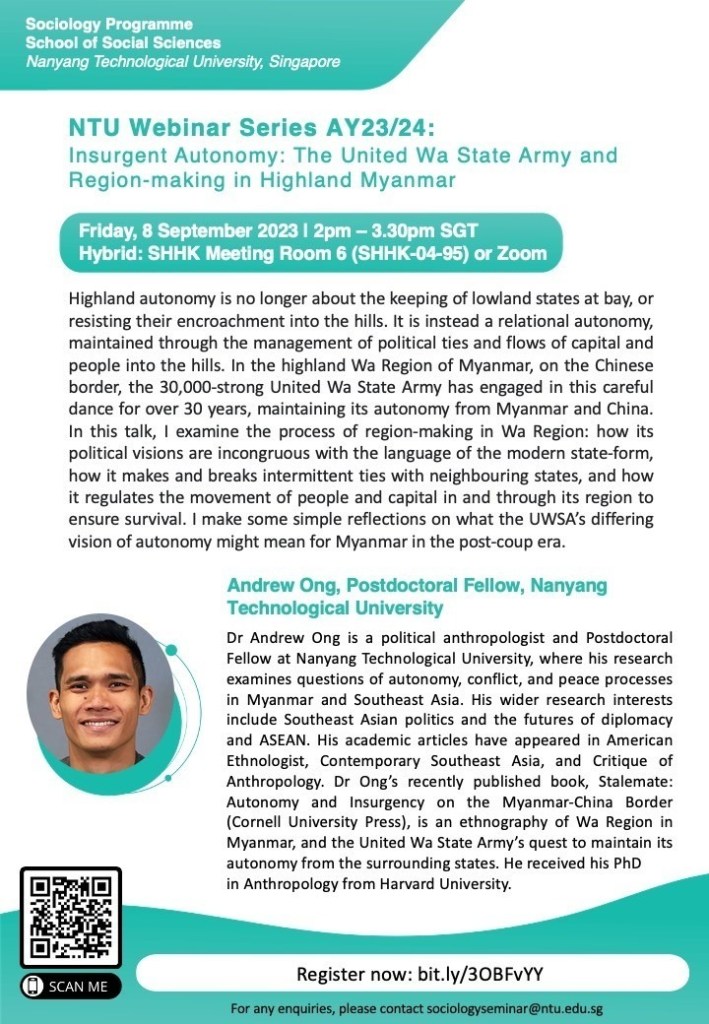
“Musical Means: Cultural Techniques of Disentangling in Littoral Myanmar”

Friedlind Riedel

Date / Time: Tuesday, September 26 at 7:30 pm Newfoundland time (22:00 UTC)

Description:

This talk navigates the conceptual waters between two texts: the commentarial works on the Theravāda Abhidhamma by fifth-century philosopher Buddhaghosa, and the musical drama U Shin Gyi, Lord of Brackish Waters by librettist Ko Maung Gyi, which was published in 1905 and is staged to this day by theatrical companies or lay performers on makeshift stages along Myanmar’s littoral coast.

In keeping with the dramatic setting and the eponymous hero of the second text, the talk sets sail in brackish waters, a zone of elemental indistinction where mangrove swamps interlace land and sea and where heterogeneous domains of clean water and turbid water, nature and culture are quite literally fluid. In entangled worlds such as these, where distinctions and categories are not given in advance in the order of things, a basic principle of Abhidhamma thought becomes evident: namely, that it requires tools and techniques of parsing and disentangling—just like a “man standing on the ground and taking up a well-sharpened knife might disentangle a great tangle of bamboos” as Buddhaghosa puts it—to discern and distinguish fundamental entities, categories, and relations. In the musical drama, the tool at hand is not a knife but a musical instrument, the saung gauk (curved harp). Since harps operate quite differently from knifes and since techniques of music making differ sharply from techniques of mindfulness, these procedures each fashion very distinct modes of existence.

This talk takes propositions from Abhidhamma thought, ones that thoroughly destabilize the epistemic frameworks that undergird much scholarship on music and sound, as its point of departure. Close attention to the operational logic of the Burmese harp, however, complicate any simple correspondence between Buddhist thought and musical practice.

Bio: Friedlind Riedel is a researcher at Bauhaus-Universität Weimar working on her monograph “Staging listening: Histories and Techniques of Musical Drama in Myanmar” which is based on longitudinal ethnographic and archival research. She is co-editor of the Oxford Handbook of the Phenomenology of Music Cultures and has published extensively on music and atmosphere. Her current work sits in the midst of Theravada Buddhist thought, media philosophy, (ethno-)musicology and sound studies.
Event: Matthew Venker on religious racialisation in colonial Burma

“Between Bama and Batha: Considering religious racialisation in colonial Burma”

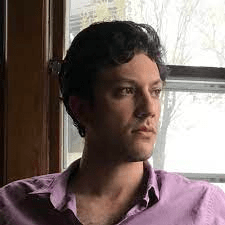
Speaker: Matthew Venker, Southeast Asia Program, Cornell University 
Date: Tuesday 26 September 2023
Time zone: 12-1pm (AEST), 8.30-9.30am MMT 

register here

Abstract

Scholarship on Myanmar, from its colonial history, to its citizenship crises, and the 2021 coup, has heretofore critically interrogated the relationship between ethno-racial identity and socio-political power. However, we have yet to address one important question: what exactly is the difference between ‘ethnicity’ and ‘race’ in the context of Myanmar? This dialogue proposes the utility of reading Burmese history through the analytic lens of critical race theory to identify ethnicity and race as separate, though related, social processes, each with distinct ramifications. This talk will present new research on family law litigation involving mixed Chinese-Burmese Buddhist families in the wake of the ‘British Burma Law’s Act’ (1898-1948) to make the case that racialisation in Burma is drawn along lines of religious rather than ethnic distinction, and that it has historically been drawn along highly gendered lines.

Matthew Venker  is a cultural anthropologist studying the historical intersections of race, religion, and citizenship in Burma. His dissertation, Racial Categories, Religious Distinctions: Mixed Buddhists and the Burma Laws Act 1898-1947, interrogates how British colonial structures created new categories of legal personhood that divided the colony’s Buddhist population. He earned his Ph.D. from the University of Wisconsin-Madison in May 2023. He is currently a Visiting Fellow with the Southeast Asia Program, Cornell University.

Recent Pubs, 18 Sept 2023

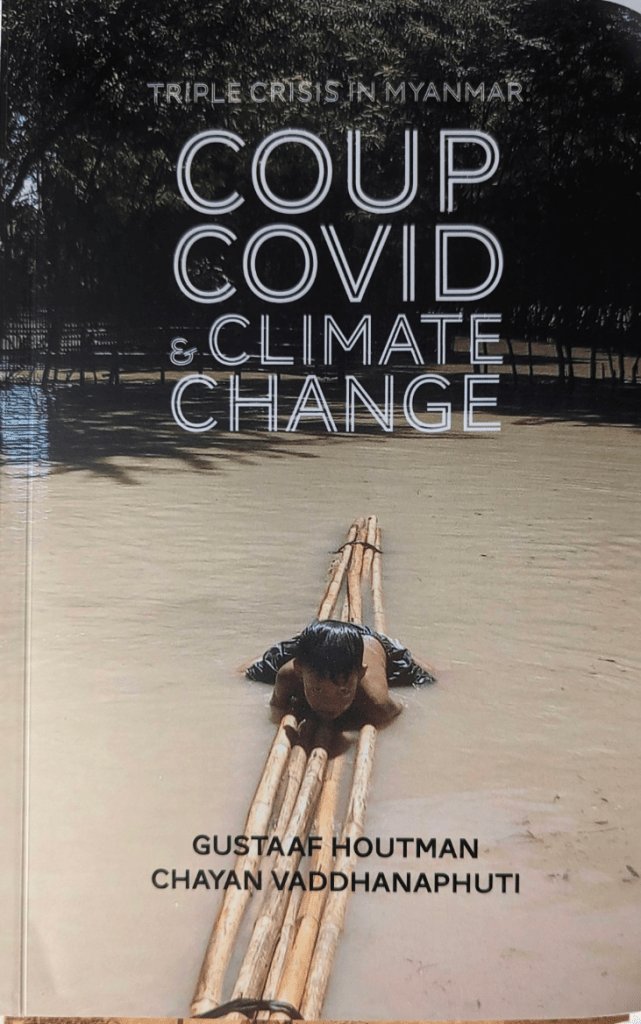
This week’s New Pubs features Houtman and Chayan editing a volume by Myanmar writers on coup, covid, and climate change; Zun Wai Oo and Kawai on the impact of the pandemic and the coup on inclusive education in Burma; and Zahed on the consequences of the 2021 coup for the Rohingya.

As ever, see our Recent Publications page for all of the citations and for past weeks, and if anyone wants a PDF but is excluded by pay wall, please email us and we will help if we can.

Event: Thein-Lemelson on white shirts as sacred amulets for Burmese activists (20-sept-2023)

Wednesday, September 20, 2023
12:00 Noon EDT New Haven Time

zoom register here.

WHITE SHIRTS AS SACRED AMULETS: “WORLD-MAKING” AND “SELF-MAKING” DURING THE BURMESE POLITICAL FESTIVAL

Seinenu M. Thein-Lemelson, PhD
Anthropology Department, University of California, Los Angeles

Drawing upon Stanley J. Tambiah’s idea of “world conquerors” and “world renouncers,” I examine the Burmese political festival (nainganyei pwe) as a ritual, affective, and material space where former political prisoners reinterpret violence and engage in forms of collective and personal “world-making.” The lecture focuses on one practice in particular: the ritual wearing of white shirts by the 88 Generation. It is argued that there are psychological benefits to donning this symbolic attire. Like sacred amulets described by Tambiah, the white shirt provides ontological security to former political prisoners. For leaders (gaungzaungs) in the movement, the white shirts are integral to how they create and embody power, becoming conduits of charismatic authority. Within the context of the nainganyei pwe and when combined with other “technologies of the self,” the white shirts create a feeling of inviolability and allow survivors of political violence to reassert personal and collective agency. In addition to extending the literature on the sedimentation of power and charisma in objects to contemporary politics in Myanmar, I also attempt to unpack the tensions between precarity versus inviolability and self-making versus selflessness in the “political sacred” space of the nainganyei pwe and the broader cultural system of the Burmese democracy movement.

Seinenu M. Thein-Lemelson, PhD, has been conducting long-term ethnographic and psycho-cultural research in Burma (Myanmar) since 2008. She received her PhD in Developmental Psychology, with a specialty in Culture, Brain, and Development, from the University of California, Los Angeles (UCLA) in 2013. From 2015 to 2016, she was a Templeton-funded postdoctoral researcher at the Institute of Personality and Social Research (IPSR) at the University of California, Berkeley. From 2016 to 2019, she was a Visiting Scholar in the Department of Anthropology at the University of California, Berkeley. Dr. Thein-Lemelson has worked with former political prisoners and democracy activists in Burma since 2013 and is finishing a book-length ethnographic study on the Burmese Democracy Movement. Dr. Thein-Lemelson is also currently a lecturer in the Department of Anthropology, University of California, Los Angeles, where she teaches undergraduate classes on “The Anthropology of Burma/Myanmar,” “Political Imprisonment,” and “Social Movements and Controlling Processes.”

Recent Pubs, 11 Sept 2023

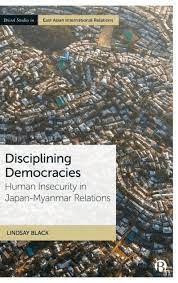
This week’s New Pubs features Black with a book on Japan-Myanmar relations; Lewis on intellectuals in Cold War Burma; and Neef et al on the relationship between conflict, climate change, and displacement for Rohingya in Bangladesh.

As ever, see our Recent Publications page for all of the citations and for past weeks, and if anyone wants a PDF but is excluded by pay wall, please email us and we will help if we can.

Recent Pubs, 4 Sept 2023

This week’s New Pubs features Cheesman’s book on key political terms and concepts in Myanmar; Steinhübel-Rasheed and Minten on the effects of conflict on small-holder production; and Saw Kyaw Zin Khay et al on human security in Myanmar after the coup.

As ever, see our Recent Publications page for all of the citations and for past weeks, and if anyone wants a PDF but is excluded by pay wall, please email us and we will help if we can.

Recent Pubs, 28 August 2023

This week’s New Pubs features Johnson’s book on empire, gender, and Charlotte Wheeler-Cuffe in Burma; Myo Win and Arraiza on Burmese citizens’ citizenship challenges after the coup; and Cao on how India and Burma decided on recognizing the PRC in 1949.

As ever, see our Recent Publications page for all of the citations and for past weeks, and if anyone wants a PDF but is excluded by pay wall, please email us and we will help if we can.

^ Charlotte Wheeler-Cuffe