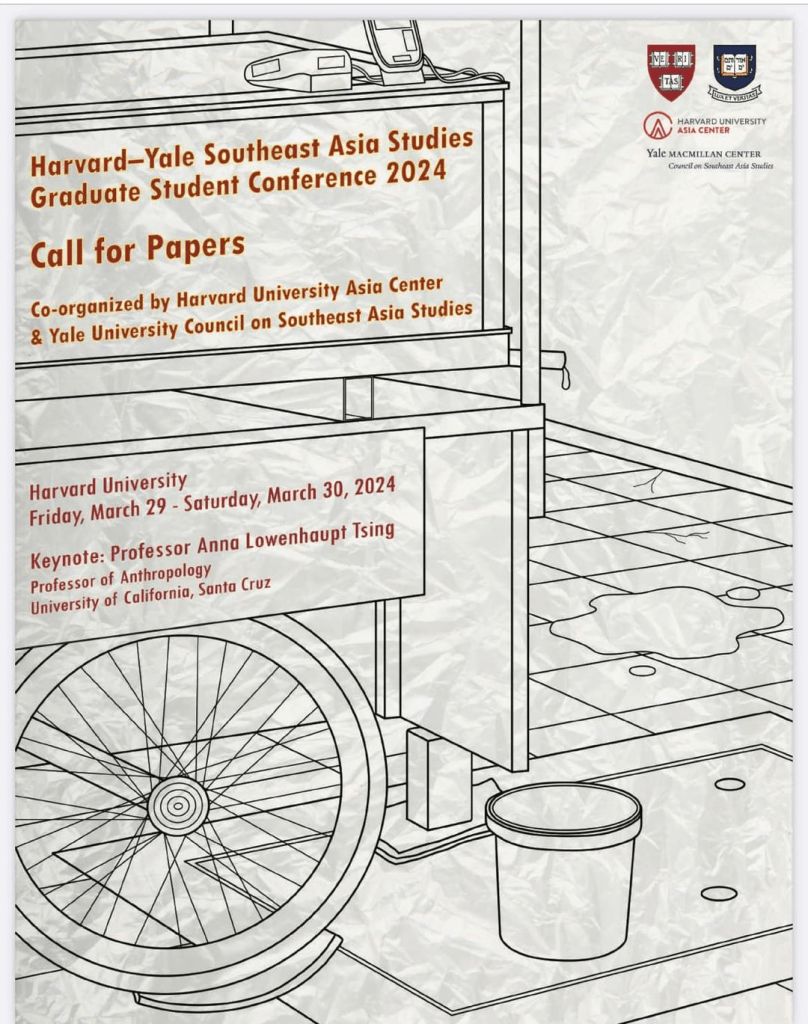
while Harvard hasn’t exactly covered itself in glory lately, and in our professional opinion should be mocked as much as possible, it still throws a good conf from time to time – especially when the inimitable Anna Tsing is involved!
This week’s New Pubs features Thayza Thara and Veetakarn on Burmese linguistics (aspect); Buscemi and Proto on “telluric geographies” and weapons in Myanmar’s borderlands; and Palmiano Federer with some “unsettled reflections” from Yangon’s Golden Valley.
As ever, see our Recent Publications page for all of the citations and for past weeks, and if anyone wants a PDF but is excluded by pay wall, please email us and we will help if we can.
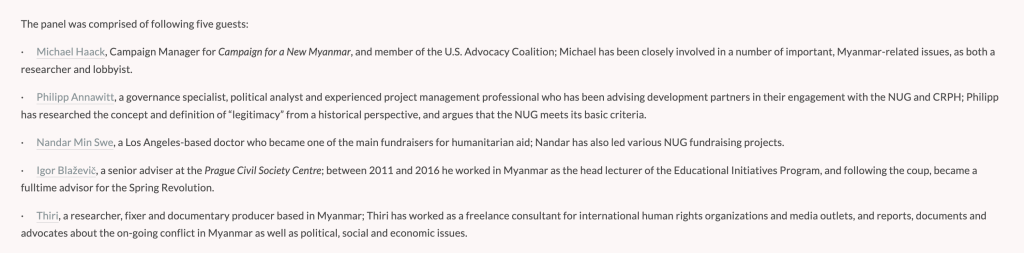
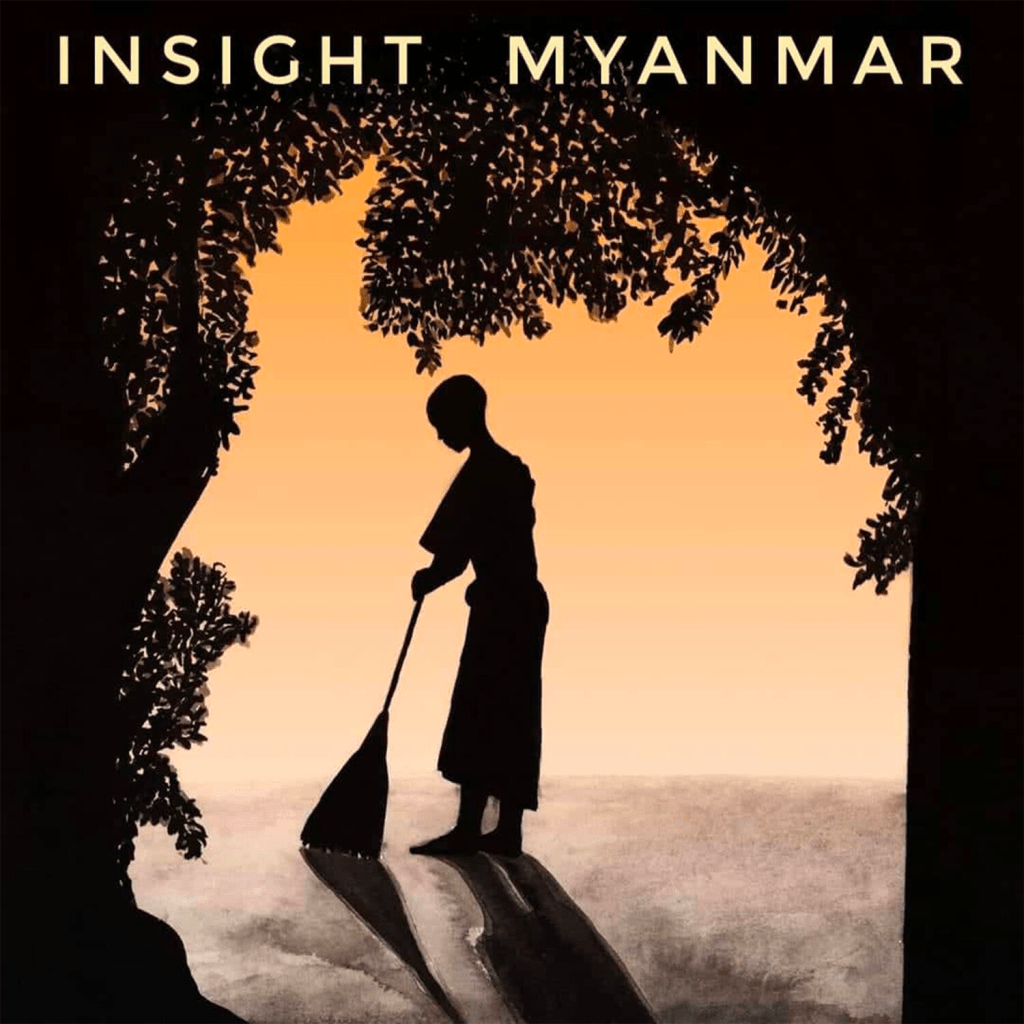
This week’s New Pubs features Dean on the local dynamics of BRI in Northern Myanmar; Liew et al analyzing Obama’s “pragmatic liberalism” in Burma; and Insight Myanmar podcast’s panel discussion on why Myanmar’s struggle for democracy has been ignored, with five speakers (see image below).
As ever, see our Recent Publications page for all of the citations and for past weeks, and if anyone wants a PDF but is excluded by pay wall, please email us and we will help if we can.
This week’s New Pubs features Edwards on Graeber, Leach, and Revolution in Myanmar; IISS on how Competing armed groups pose new threat to Rohingya in Bangladesh; and Ware and Skidmore with an edited volume “After the Coup: Myanmar’s Political and Humanitarian Crises.”
As ever, see our Recent Publications page for all of the citations and for past weeks, and if anyone wants a PDF but is excluded by pay wall, please email us and we will help if we can.
Australian National University offers an online Burmese language course for a degree (Minor) for students within ANU, and other universities in Australia through ANU’s cross-institutional program. For those who wish to learn the language only, the best way is to enrol through the Open Universities of Australia as their tuition fee is very reasonable. Please refer to the links as shown below.
2024 Semester 1 course (Burmese 1 and Burmese 3) will start on 19 February!
*Burmese 2 and Burmese 4 will be offered for 2024 Semester 2 (begins on 22 July).
The syllabus of ANU Burmese course is designed as teaching Burmese as a foreign language for adult learners, including the second generation of Myanmar families who have grown up speaking English.
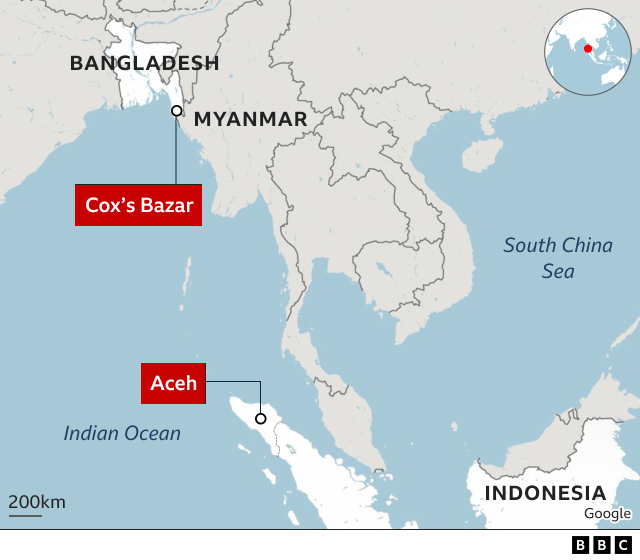
This week’s New Pubs features Rahman at al on the role of religion for Rohingya life in Aceh; Deejay et al on Facebook’s damaging utopian narratives of technologically-driven social change in Myanmar; and Wardani and Shahpur consider interpretation and positionality in Rakhine state.
As ever, see our Recent Publications page for all of the citations and for past weeks, and if anyone wants a PDF but is excluded by pay wall, please email us and we will help if we can.
** Our cupboard is a bit dry here, so if you have pubs you want to circulate, please send them on **
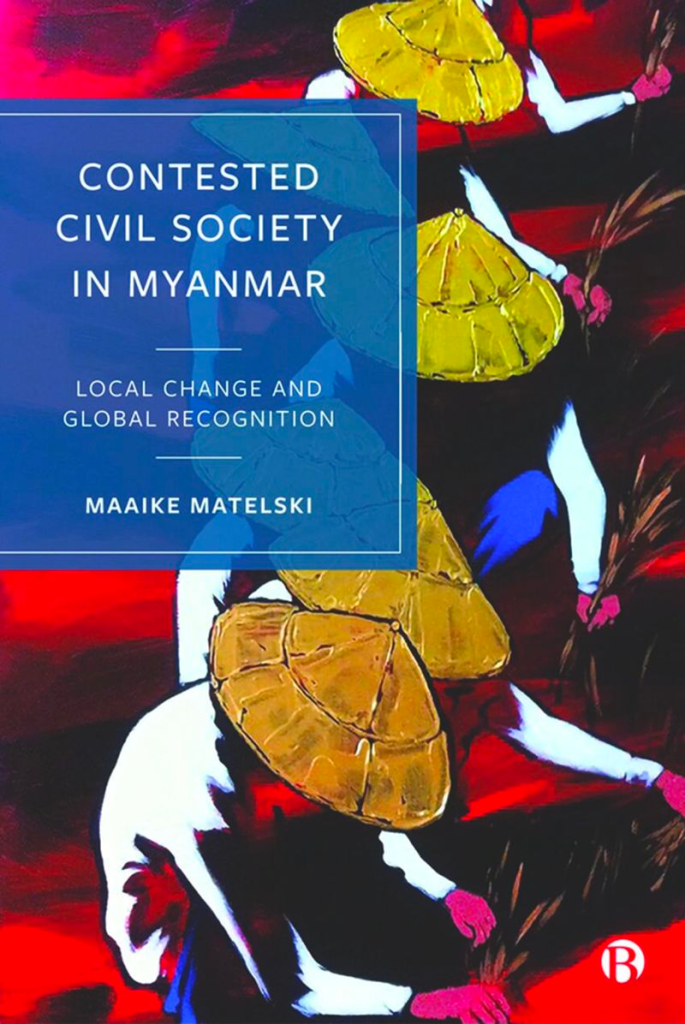
This week’s New Pubs features Matelski on contested civil society in Myanmar; Stokke and Nyi Nyi Kyaw on revolutionary resistance to full autocratization; and Ganesan on whether the coup is paving a revolutionary road to democratization.
As ever, see our Recent Publications page for all of the citations and for past weeks, and if anyone wants a PDF but is excluded by pay wall, please email us and we will help if we can.
‘Call for small research proposals – Myanmar’s current issues in the “digital space”’
The Knowledge for Democracy Myanmar (K4DM)-Phase-II Initiative run program invites researchers in Myanmar and the diaspora to submit proposals for research projects on issues of importance to the many social, political and economic challenges facing Myanmar and its citizens. We are particularly interested in research making use of digital tools (online surveys, online focus groups, etc) as well as research at the intersection of digital technology and current policy affairs (see more on topics below).
Gosling-Lim Postdoctoral Fellowship in Southeast Asian Studies
This fellowship is focused on capability-building in Southeast Asian Studies among scholars who are Southeast Asian nationals based in Southeast Asia and at Southeast Asian institutions. Its goal is to enable such scholars to concentrate on publishing their dissertation research, and/or embark on new post-dissertation research, without the distraction of having to teach, consult, or shoulder administrative burdens, and with the opportunity to expand their scholarly networks and expertise. The intent is that fellowship recipients will develop their careers in Southeast Asia, helping to advance the field of Southeast Asian Studies within the region.
The fellowship provides US $52,000 of funding for postdoctoral research and writing, to be expended over 8-12 months while the recipient is in residence or otherwise based at an academic institution, in Southeast Asia or abroad, other than their home institution and the institution at which their doctorate was obtained. The fellowship may be used in any discipline and for any country of Southeast Asia (i.e., Brunei, Cambodia, Indonesia, Lao PDR, Malaysia, Myanmar, Philippines, Singapore, Thailand, Timor-Leste, Vietnam).
This week’s New Pubs features Buscemi on the political ecologies of landmines in Myanmar’s borderlands; Morton on the double bind of indigeneity in Myanmar; and Crouch & Hmung on law and military overreach during Myanmar’s Covid-19.
As ever, see our Recent Publications page for all of the citations and for past weeks, and if anyone wants a PDF but is excluded by pay wall, please email us and we will help if we can.




 Burma Studies Group