The University of British Columbia’s (UBC) Myanmar Initiative is delighted to invite applications for the 2024 Myanmar Emerging Scholars and Young Leaders Workshop. It is set to take place at UBC’s campus in Vancouver, Canada, from May 15th to 17th, 2024. This workshop is designed to empower emerging scholars and young leaders from Myanmar, of Myanmar origin, or working on Myanmar. Participants will have the opportunity to strengthen their network, enhance their contributions to Myanmar’s democratic development, and engage in meaningful collaboration and professional activities. This workshop is made possible through the generous support from the International Development Research Centre’s (IDRC) Knowledge for Democracy Myanmar (K4DM) initiative.
Workshop Highlights:
Networking opportunities with a diverse group of Myanmar scholars and researchers.
Skills training tailored to foster professional growth.
A platform to present research and gain valuable feedback from peers and experts.
Financial support for travel and accommodation for workshop attendees.
Application Deadline:
Please submit your applications by February 28, 2024. The review of applications will begin on March 1, 2024.
Eligibility Criteria:
Geared primarily to individuals currently enrolled in MA or PhD programs, with a preference for students at Canadian universities, though postdoctoral fellows and research affiliates are also encouraged to apply.
A strong focus on research related to Myanmar, particularly projects aligned with the priorities of Global Affairs Canada and IDRC, including gender, vulnerable minorities, and the Rohingya community.
We welcome applicants from all academic disciplines, with a particular interest in those from the social sciences and humanities.
We highly encourage applications from women and members of vulnerable minorities.
Application Process:
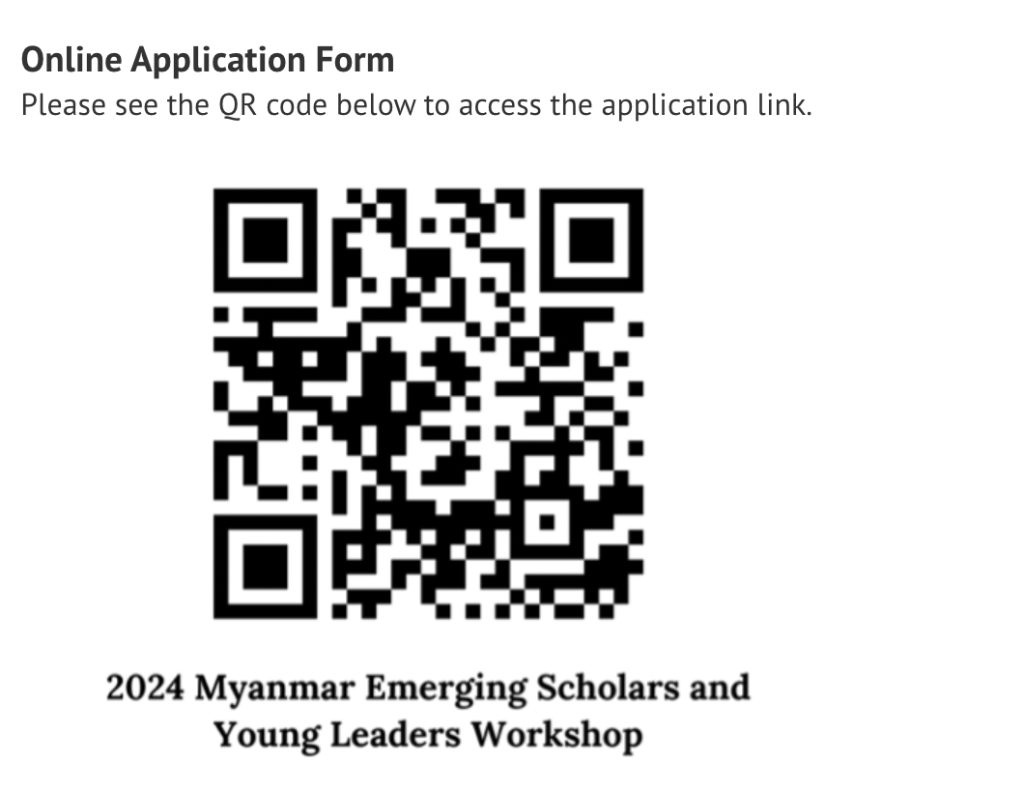
To apply for the workshop, please fill out the online application form available https://forms.gle/tdhW4z44hCxaC9UV9. Ensure your application includes a brief description of your research project and how you believe the workshop will benefit your work and professional development.
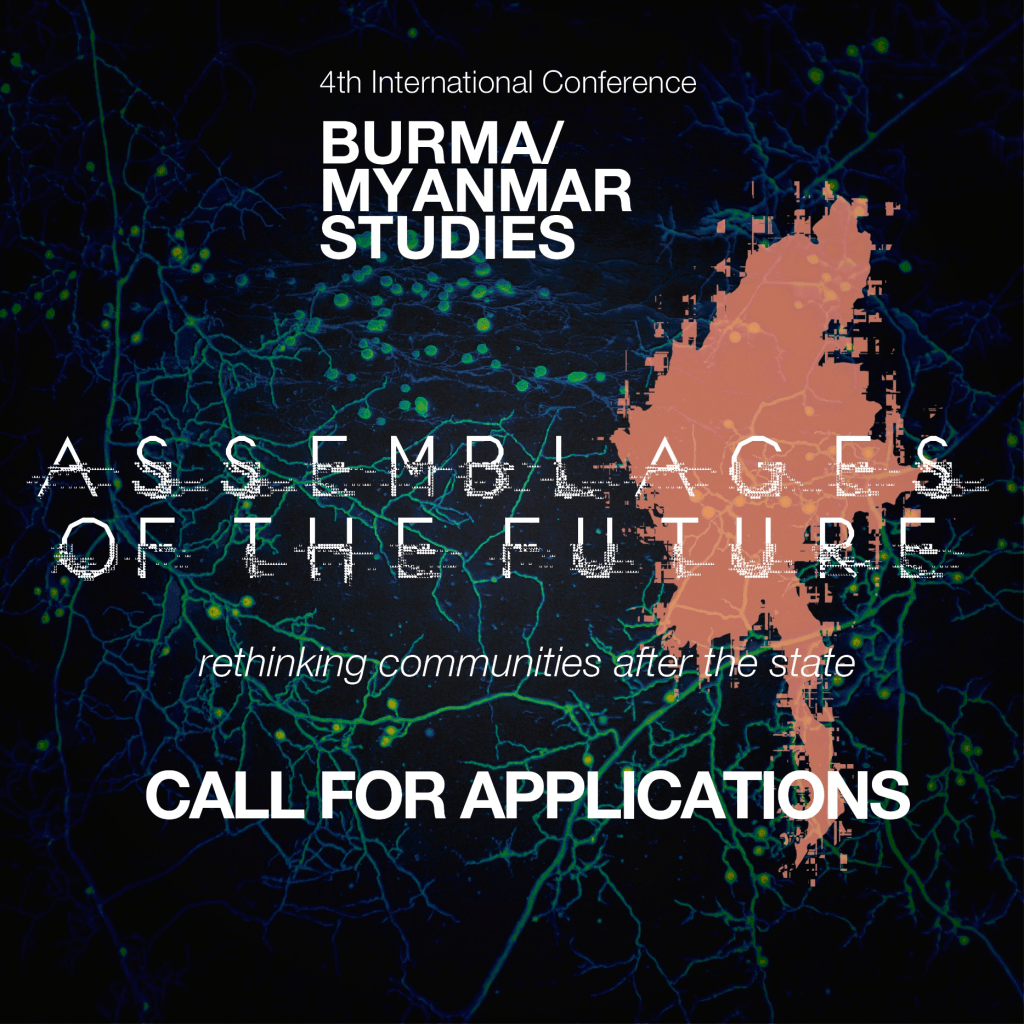
Save the date; August 2-4, 2024! The ICBMS – International Conference on Burma/Myanmar Studies committee invites abstract submissions for ICBMS 4! This round of ICBMS will be hosted at Chiang Mai University on 2 – 4 August 2024 under the title “Assemblages of the Future: Rethinking Communities after the State.”
Interested participants should submit an abstract of not more than 300 words along with keywords. Panel proposals should be not more than 500 words. Panel descriptions should contain a 300-word abstract for each presenter. The website for abstract submission, online registration and fee information will be available online soon at https://burmaconference.com Currently, further information is available via email; please contact the ICBMS4 Secretariat at icbms.cmu[at]gmail.com. Read full detailed conference themes and conference description through the link below.
This week’s New Pubs features Sadan on Kachin communities in Myanmar; Mohapatra on human security issues in Myanmar; and UNSW Centre for Ideas’ interview with Sean Turnell on his imprisonment.
As ever, see our Recent Publications page for all of the citations and for past weeks, and if anyone wants a PDF but is excluded by pay wall, please email us and we will help if we can.
This week’s New Pubs features Aung on Myanmar’s revolutionary present; Saha on peasant insurgency in colonial Myanmar; and Insight Myanmar with a panel podcast “A Taste of Resilience” on Burmese food in a time of revolution.
As ever, see our Recent Publications page for all of the citations and for past weeks, and if anyone wants a PDF but is excluded by pay wall, please email us and we will help if we can.
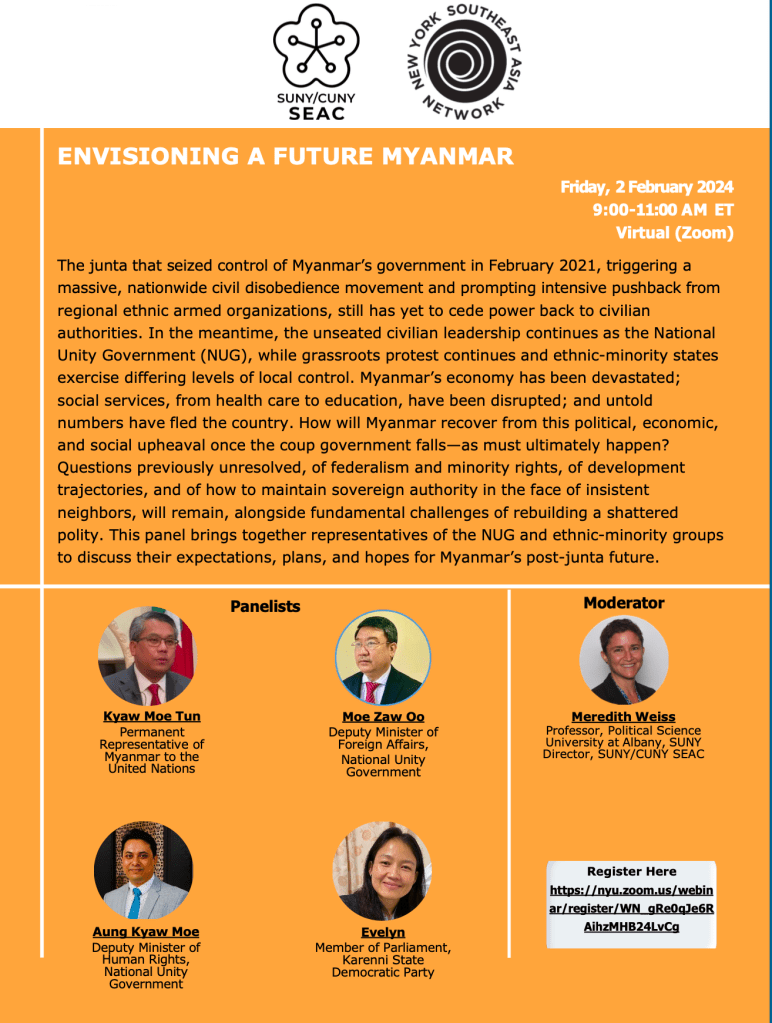
The junta that seized control of Myanmar’s government in February 2021, triggering a massive, nationwide civil disobedience movement and prompting intensive pushback from regional ethnic armed organizations, still has yet to cede power back to civilian authorities. In the meantime, the unseated civilian leadership continues as the National Unity Government (NUG), while grassroots protest continues and ethnic-minority states exercise differing levels of local control. Myanmar’s economy has been devastated; social services, from health care to education, have been disrupted; and untold numbers have fled the country. How will Myanmar recover from this political, economic, and social upheaval once the coup government falls—as must ultimately happen? Questions previously unresolved, of federalism and minority rights, of development trajectories, and of how to maintain sovereign authority in the face of insistent neighbors, will remain, alongside fundamental challenges of rebuilding a shattered polity. This panel brings together representatives of the NUG and ethnic-minority groups to discuss their expectations, plans and hopes for Myanmar’s post-junta future.
Kyaw Moe Tun – Permanent Representative of Myanmar to the United Nations
Kyaw Moe Tun currently serves as the Permanent Representative of Myanmar to the United Nations in New York. From 2018–2020, he served as Myanmar’s Permanent Representative to the United Nations Office and other international organizations in Geneva, as well as to the Conference on Disarmament, the World Trade Organization, and the Organisation for the Prohibition of Chemical Weapons, while serving concurrently, too, as Ambassador to Switzerland. Before his appointment to the UN, from 2016–2018, he served as director-general of the International Organizations and Economic Development Department under the Ministry of Foreign Affairs. He has held posts also in Myanmar’s embassies in Jakarta and Singapore. Following the 2021 coup, he remained loyal to the civilian government and resisted the military regime’s attempt to remove him from his post.
Moe Zaw Oo – Deputy Minister of Foreign Affairs, National Unity Government
Moe Zaw Oo actively participated in students’ demonstrations and later nationwide uprisings in 1988 when he studied at the Rangoon Arts and Science University. Then he joined the National League for Democracy led by Daw Aung San Suu Kyi in September 1988. He was arrested in 1990 for his involvement in political activities and released in 1999. He received a master’s degree after studying at the Chulalongkorn University in Thailand while he was in exile. Upon return to Myanmar in 2012, he served as a deputy Chief of Staff to the office of the NLD Chairperson – Daw Aung San Suu Kyi and then became the Chief of Staff of the office in February 2016. He received a degree from a post-graduate course in international strategic studies at the Royal College of Defence Studies in London in 2017. He served as an advisor to the Union Peace Commission until the attempted coup in February 2021. He is an Executive Director of the Daw Khin Kyi Foundation – a charity organization chaired by Daw Aung San Suu Kyi. He was appointed by the CRPH and the National Unity Consultative Council as a deputy minister for the Foreign Affairs of the National Unity Government of Myanmar in April 2021.
Aung Kyaw Moe – Deputy Minister of Human Rights, National Unity Government
Aung Kyaw Moe is Deputy Minister at the Ministry of Human Rights of the National Unity Government and is a prominent Rohingya human rights activist and humanitarian. He has been awarded various international awards, including the 2019 Schuman Award by the EU, the French Republic Human Rights Prize by the French Government, and a global pluralism award. Aung Kyaw Moe has worked with diverse international organizations for over 15 years in Myanmar, Thailand, Bangladesh, Afghanistan, and Liberia. He has a Master’s Degree in Humanitarian Assistance from Deakin University, Australia. He is a Bush Liberty and Leadership Fellow at the Bush Presidential Center and completed both an Asia Pacific Leaders Fellowship at the Obama Presidential Center and a Dalai Lama fellowship at the United States Institute for Peace.
Evelyn – Member of Parliament, Karenni State Democratic Party
Evelyn is an elected Member of Parliament for the Karenni State Democratic Party, having won her seat in the 2020 general election for the Karenni State Assembly. She is a member of the Karenni State Interim Parliament. She was a member of the National Consultative Council and a Karenni State Consultative Council (KSCC) representative. She was elected vice-chairperson of the KSCC after the first congress of the KSCC in January 2023.
Moderator: Meredith Weiss
Professor of Political Science, University at Albany, SUNY
Min Zin is the executive director of the Institute for Strategy and Policy-Myanmar, an independent, nongovernmental Myanmar think-tank. He is a PhD candidate in Political Science at the University of California, Berkeley. Min Zin studies comparative politics with a special focus on civil-military relations, democratization, and contentious politics, and has written for the New York Times and Foreign Policy, among others. His writings appear in many edited volumes, Journal of Democracy, Journal of Current Southeast Asian Affairs, Social Research: An International Quarterly, Contemporary Southeast Asia, and Asian Survey.
Mary Callahan is Associate Professor in the Henry M. Jackson School of International Studies at the University of Washington. She teaches classes on Southeast Asian politics, Human Rights in Asia, and The Politics of Development Assistance. On leave from the university, she spent twelve years based in Yangon, Myanmar, where she carried out research on election politics, political economy, census methodology, gender issues, and conflict dynamics. She is currently working on a book manuscript on revolutionary politics in the Dry Zone.
This week’s New Pubs features Roberts and Girke on the troubling potential of the Secretariat; Cheong on how Rohingya are racial excluded by bureaucratic omission; and Easley and Chow on China’s support of Myanmar (as well as other pariah countries).
As ever, see our Recent Publications page for all of the citations and for past weeks, and if anyone wants a PDF but is excluded by pay wall, please email us and we will help if we can.
Richard Horsey is a widely published political analyst and has been a close observer of Myanmar for over 25 years. He specializes in the politics, political economy and illicit economy of the country, as well as the armed conflict. Since 2009, he has been Senior Adviser on Myanmar to the International Crisis Group, and also advises a number of other organisations. He was formerly the Myanmar representative of the International Labour Organization (2002-2007) working to end the practice of forced labour imposed by the previous military regime. He was subsequently a senior adviser and spokesperson for the United Nations Office for the Coordination of Humanitarian Affairs following Cyclone Nargis. He is the author of more than a hundred reports on Myanmar, as well as numerous articles and opinion pieces. He is a fluent Burmese speaker and holds a PhD in psychology from University College London.
Min Zin is the Executive Director of the Institute for Strategy and Policy – Myanmar. The Institute for Strategy and Policy – Myanmar is an independent, non-partisan and non-governmental think tank. Established in 2016, it aims to promote democratic leadership and strengthen civic participation in Myanmar through its key strategic programs and initiatives. The Institute primarily focuses on research, capacity building, leadership engagement, communication and outreach programs, and desk initiatives on peace and China issues.
Questions and Answers will follow the presentations.
This week’s New Pubs features Ohmar Khine inquiring whether the BSPP created jobs equitably; Kudo on the relationship between the coup and economic growth; and Saung Yanant Pyae Kyaw and Sasiphattra on post-coup China/Myanmar relations.
As ever, see our Recent Publications page for all of the citations and for past weeks, and if anyone wants a PDF but is excluded by pay wall, please email us and we will help if we can.
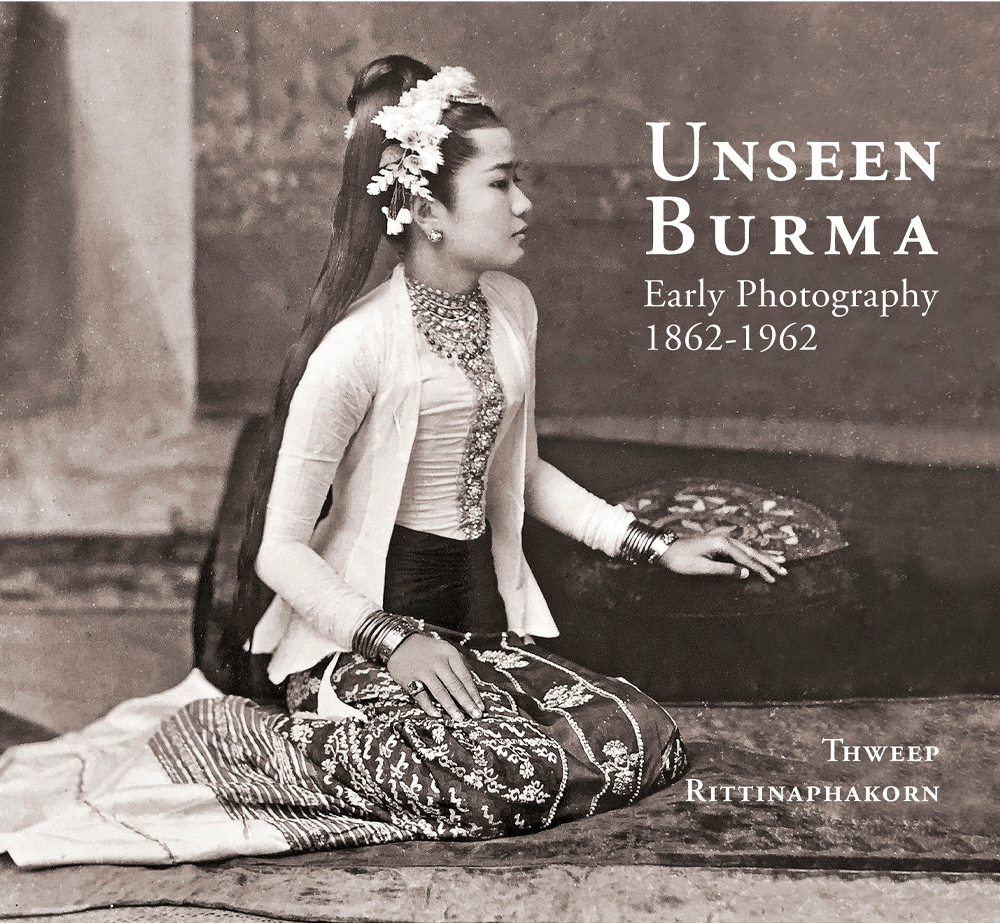
This week’s New Pubs features Lubina on Burmese political thought as seen through U Thant and ASSK; Thweep’s book on photography in Burma between 1862-1962; and Chessman’s short book on Myanmar’s political lexicon (Open Access until 25 January!)
As ever, see our Recent Publications page for all of the citations and for past weeks, and if anyone wants a PDF but is excluded by pay wall, please email us and we will help if we can.





 Burma Studies Group