This week’s New Pubs features Kyed on legal pluralism in Myanmar; McCormick on English in Myanmar; and Thawnghmung and Naw Moo Moo Paw on the post-coup role of local state administrators.
As ever, see our Recent Publications page for all of the citations and for past weeks, and if anyone wants a PDF but is excluded by pay wall, please email us and we will help if we can.
Australian Research Council Centre of Excellence for the Elimination of Violence against Women (CEVAW) is seeking to appoint a Research Fellow, for three years. The successful candidate is expected to make outstanding contributions to research in CEVAW, especially, the ANU node on migration, displacement, and trafficking.
Salary package: $110,162 – $124,903 per annum plus 17% superannuation Term: Full-time, Fixed Term (up to three years)
app due: 24 March
“Our ideal candidate will hold a PhD in International Relations or a related discipline. They will have a developing record of outstanding scholarly publications in the fields of International Relations and/or Global Politics, Human Rights, International Law, alongside a proven track-record of research in sexual and gender-based violence. We are particularly interested in someone with specialism in humanitarian emergencies, violence against women and girls in displacement and trafficking contexts, and who has a familiarity with global/local nuances of humanitarian protection work with civil society actors. We are looking for someone with the capacity to work collaboratively with colleagues – both academic and professional and partner organisations in Australia and in the Indo-Pacific region.”
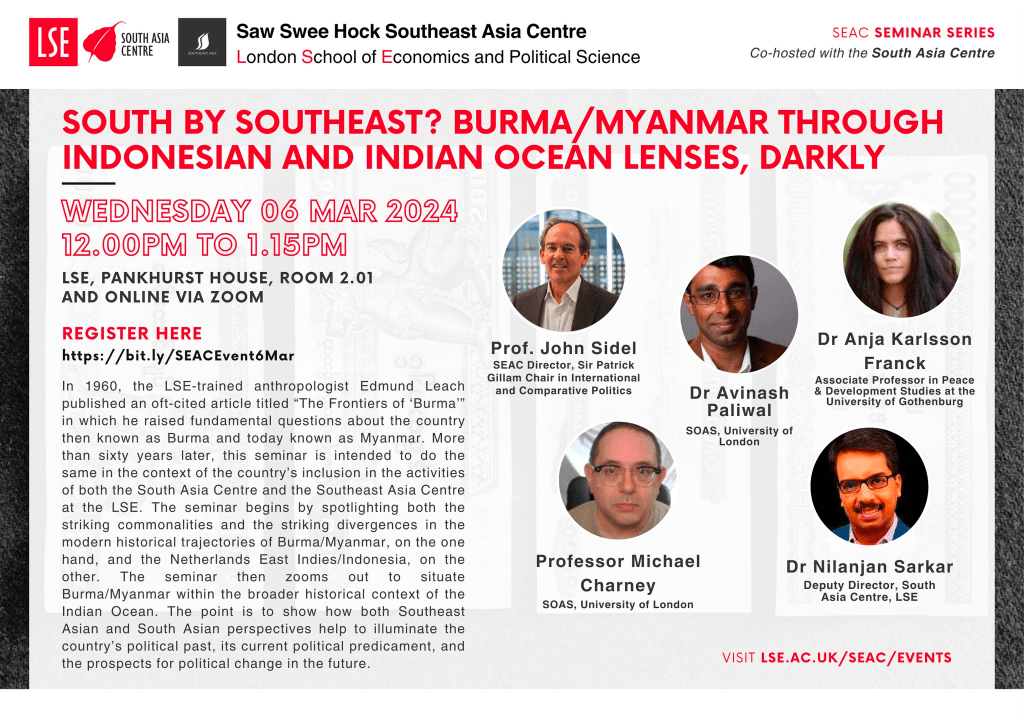
The panel will explore Burma/Myanmar’s history and its place in Southeast Asian and Indian Ocean narratives. This seminar revisits critical questions about Burma/Myanmar’s political past and future, inspired by Edmund Leach’s seminal work.
Speakers: Prof. John Sidel, Dr. Avinash Paliwal, Prof. Michael Charney, and Dr. Anja Karlsson Franck
This week’s New Pubs features Wittekind on speculation in peri-urban land markets; Brenner on misunderstanding Myanmar through the lens of democracy; and Verma on Rohingya access to education in India.
As ever, see our Recent Publications page for all of the citations and for past weeks, and if anyone wants a PDF but is excluded by pay wall, please email us and we will help if we can.
“Competing regimes and multiple stakeholders: How China hedges its relations with Myanmar” Speaker: Dr Enze Han, Associate Professor, The University of Hong Kong Date: Tuesday 5 March 2024 Time zone: 5–6pm AEDT (UTC+11), 12.30–1.30pm MMT, 11.30am–12.30pm IST Zoom here
This week’s New Pubs features Takahashi’s book on the socio-economic history of rural Myanmar between 1986 and 2019; Wießmann on the transition from unarmed to armed resistance; and Charney on the Arakan Army in the context of a divided Myanmar.
As ever, see our Recent Publications page for all of the citations and for past weeks, and if anyone wants a PDF but is excluded by pay wall, please email us and we will help if we can.
The Myanmar Research Network at University of Melbourne in collaboration with the Myanmar Research Centre at Australian National University (ANU) with the generous support from the International Development Research Centre, Canada, invite expressions of interest for a Myanmar scholar/researcher for a fully funded 4-week fellowship in Australia. We are offering two fellowship opportunities in 2024, one in the first half of the year and the other in the second.
The fellowship includes two weeks at University of Melbourne and two weeks at the ANU in Canberra. The goal of the fellowship program is to build deeper connections between University of Melbourne/ANU and Myanmar academics and researchers in the region and catalyze new high quality collaborative research.
The fellowship offers
Fully funded accommodation and travel from anywhere in the Asia-Pacific, and within Australia, visa cost reimbursement, and a living allowance for food and essentialsFacilities to do research at both universities with a view to contributing to work on an academic publication by the fellow, and possible collaborative work on later publicationsOne-year remote access to library facilities Fellows are expected to
Give one or more seminars or public lectures in Melbourne and CanberraMake one or more contributions, in Burmese or English, to working papers or blogs at either or both universitiesMeet with researchers to discuss and develop potential new partnerships, and with researchers and policymakers off campus as appropriate, such as NGOs and Australian Government
In 2024 we seek fellows with expertise in
Humanitarian aidHuman securityPublic health policy Applicants should have research or work experience or both, related to Myanmar, on one or more of these themes. We especially encourage applicants who have been doing research in these areas in the post-2021 context.
Eligibility
To apply you must
Be a researcher or academic of Myanmar nationality based in the Asia-Pacific (this includes those who are active in research but may not have formal institutional affiliation)Have a postgraduate research qualification (e.g., Masters’ degree with research thesis component, or a coursework Masters’ degree with other experience comparable to a research thesis). Applicants could also have completed a PhD or be a current PhD candidate.Demonstrate research interests and experience in one or more of the above identified thematic areas. Expressions of interest in other fields or areas such as medicine, law, agriculture etc will not be considered for this round.Have high-level spoken and written English (indicate examinations and qualifications in curriculum vitae).Hold a current passport that can be used to obtain an Australia visa, and be able to travel to Australia in 2024. Members of minority groups are encouraged to apply.
Shortlisted applicants will be interviewed.
Expression of interest can be made through this form.
Any questions can be directed to Tamas Wells at University of Melbourne t.wells@unimelb.edu.au
Monique Skidmore is an honorary professor at Deakin University’s Alfred Deakin Institute. She is an award- and grant-winning Burmese political and medical anthropologist and an expert media commentator. She has published seven books on Myanmar, including Karaoke Fascism: Burma and the Politics of Fear (2004). She convened the Myanmar/Burma Update conference at The Australian National University for eight years, and is co-editor of After the Coup: Myanmar’s Political & Humanitarian Crises (ANU Press, 2023).
Anthony Ware is an associate professor of humanitarianism and development at Deakin University and a former director of the Australia Myanmar Institute (2013-2017). His research, primarily in Myanmar, focuses on humanitarian and development approaches in conflict-affected situations. He has a particular interest in conflict sensitivity, ‘do no harm’, everyday peace, peacebuilding, and countering violent and hateful extremism. He has published five books, three of which are on Myanmar, including lead author of Myanmar’s ‘Rohingya’ Conflict (2018) and is co-editor of After the Coup: Myanmar’s Political & Humanitarian Crises (ANU Press, 2023)
Costas Laoutides is an associate professor of international relations at Deakin University, Australia. His area of expertise is ethno-political and separatist conflict, and its resolution. He is lead research on a project 2019-23 entitled Enhancing the work of local peace entrepreneurs after ethnic cleansing, which explores the work of actors strengthening peace formation between Rohingya and Rakhine inside Myanmar. He is the co‑author of Myanmar’s ‘Rohingya’ Conflict (Hurst/Oxford University Press, 2018, with Anthony Ware) and the sole author of Self-Determination and Collective Responsibility in Secessionist Struggle (Routledge).
Tay Zar Myo Win is a PhD candidate at Deakin University, and former lecturer at the Faculty of Political Science, Ubon Ratchathani University. His current and recent research projects explore the conflict in Rakhine State, rights of the Rohingya people, the Civil Disobedience Movement, and the process of radicalisation to extremist Buddhist nationalism. Prior to academia, Tay Zar has worked in development practice, on civic education, democracy and electoral support, and worked closely with the Union Election Commission in Myanmar as a member of a technical support team to assist national and local elections in Myanmar
This week’s New Pubs features Aung and Campbell on Myanmar’s radical tradition within a changing imperial world order; Tun Myint on the necessity of a polycentric federal democracy; and Green’s edited book on the Burma to Myanmar exhibit at the British Museum.
As ever, see our Recent Publications page for all of the citations and for past weeks, and if anyone wants a PDF but is excluded by pay wall, please email us and we will help if we can.






 Burma Studies Group