Find below details on this exciting call for papers
_______________
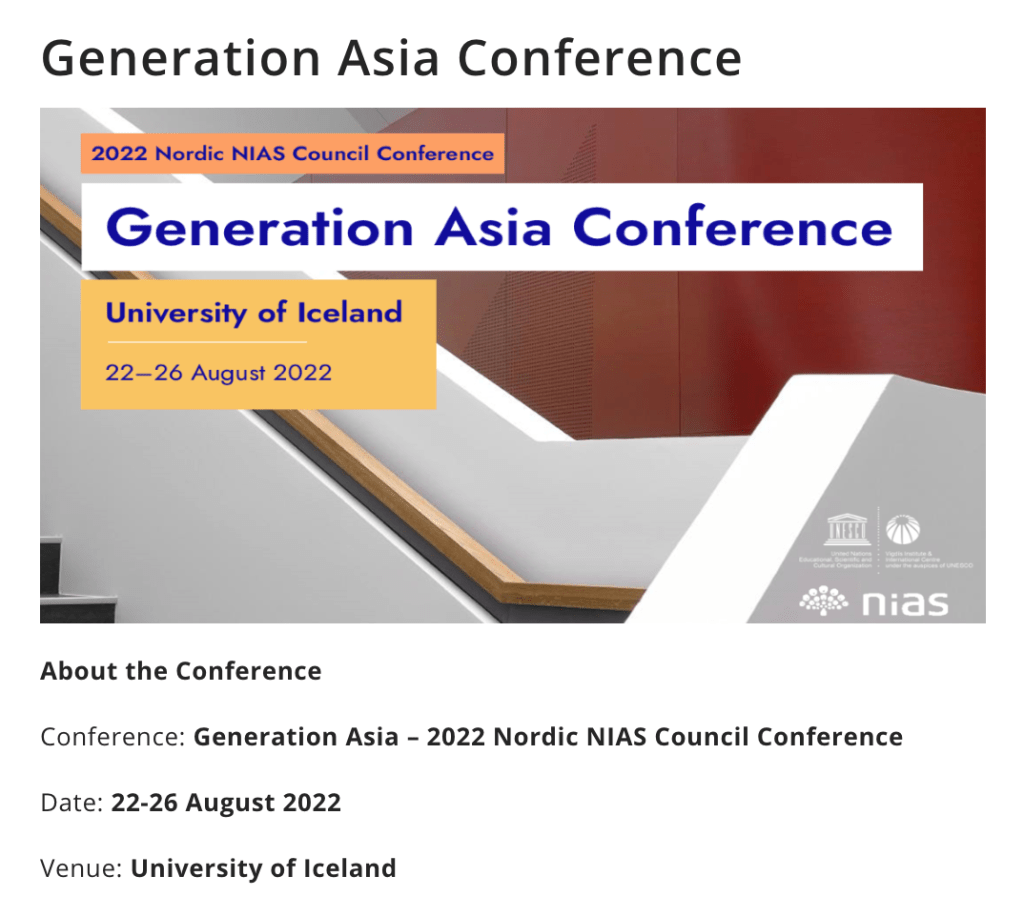
We are inviting paper proposals for our panel titled “Generations of Resistance and Revolution in Myanmar” as part of the 2022 Generation Asia Conference, held at the University of Iceland during 22-24 August 2022. Proposals should include a title and 150 word abstract, as well as your name and affiliation. All proposals should be submitted by 22 April 2022 (Friday) to gen.asia@outlook.com. Please make sure to indicate in your proposal that it is intended for the “Generations of Resistance and Revolution in Myanmar” panel. Below are our panel details. Please contact us if you have any questions. We look forward to your proposals!
Panel Title: Generations of Resistance and Revolution in Myanmar
Organizers: Dr. Terese Gagnon (teresa.gagnon@nias.ku.dk) and Dr. Van Tran (vantran@nias.ku.dk), Nordic Institute of Asian Studies
Abstract: In Myanmar, resistance movements and revolutions have been sustained to an almost unparalleled degree across generations in the 20th and 21st Centuries. Revolutions for ethnic autonomy that began shortly after Burmese Independence and continue to this day are often referred to as among “the longest wars in the world”. Similarly, world-historical anti-authoritarian resistance movements have been transmitted across multiple generations in Myanmar—currently manifested in the Spring Revolution in the wake of the 1 February 2021 coup. These resistance movements and revolutions have been sustained across generations despite considerable shifts in ideology, politics, territory, social norms, technology and more. In this panel we will explore aspects of inter-generational knowledge, affect, and political aspiration that have facilitated the distinct legacies of revolution and resistance in Myanmar. We will also examine sources of friction and sites of silence across generations. Questions discussed in this panel will include, but are not limited to: How has learning occurred across generations of revolution and resistance in Myanmar? What sources of fracture or solidarity have existed across generations? In what ways do events and experiences, rather than strictly time, shape or define generational identity?
 Burma Studies Group