This week in Deep Cuts we feature discussions of “Burmanization,” with several texts circling around state language policy and its effects. As I put this together I got writing perhaps more than I should have, so rather than subject you all too much editorial input, I will summarize here, and leave my own thoughts below the fold so to speak. Hence, we have: Callahan’s sophisticated description of Burmanization; followed by Kyaw Yin Hliang’s riposte about language policy; then flashing forward to the relative present with Lall and McCormick, respectively, with divergent analyses of the role of Burmese as medium of instruction in ethnic areas today. It finishes with Sai Kheunsai’s short but very sweet personal take on how the sit-tat state’s obtuse prohibitions of Tai language is what turned the author away from being a Bama.
Extended comments:
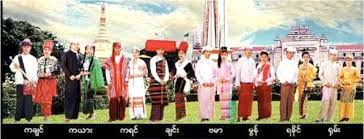
This week in Deep Cuts we feature discussions of “Burmanization,” a term that I personally believe has a vast semantic range and warrants much more exploration. We begin with a debate of sorts between Mary Callahan and Kyaw Yin Hlaing, through respective book chapters from the mid 2000s that are a bit hard to find. Callahan argues that effects of Myanmar state policy enact “Burmanization,” coming up with a sophisticated deployment of a term that most scholars, sadly, just invoke without definition. Burmanization, for Callahan, involves a simultaneous combination of homogenization and differentiation, in which all Myanmar subjects are compelled to conform to a normative unmarked Bama-ness (homogenization) even as taing-yin-tha (TYT) and other non-Bama are collated and categorized (differentiation) as a sort of divide-and-rule strategy.
Kyaw Yin Hlaing’s piece, coming a few years later, seems to respond to such claims, through an examination of the state’s language policy, given that it is often used as an exemplar of Burmanization (particularly through the sit-tat state’s prohibition of mother tongue language instruction in the 1990s and 2000s). While the piece contains unfortunate lines such as “while ethnic minorities were more interested in gaining benefits for themselves and their people than in preserving the Union, the Burman military and political leaders equated their primary duty with the preservation of the Union” (157), KYL does demonstrate that language issues were more complex than they might appear – for one, TYT elites themselves advocated for Burmese as a lingua franca, given that they felt they and their constituents would be even more marginalized by a move to a “neutral” lingua franca such as English; for another, for “smaller ethnic groups” who “outnumbered the dominant ethnic group” in a given area, Burmese was preferred as a language of instruction.
Recent research by Marie Lall buttresses these claims, finding that taing-yin-tha parents often prefer Burmese as the language of instruction to prepare their children for jobs and a life inside Burmese-language-dominated spaces. Patrick McCormick concurs, to some extent, but also finds that for taing-yin-tha whose lives are not oriented towards the Bama heartland, Burmese language is actually less relevant (and here we recall Boutry’s point about non-Bama spaces from a fortnight ago). Juxtaposing these research findings serves to remind us that Burma is not a place where space is governed in a homogenous way, casting a question on whether “Burmanization” (as a totalizing concept) is appropriate for describing such a state, and (if I may be so bold) compelling a research agenda that explores where, when, for whom, and with what intensities and effects (and affects!) does something like “Burmanization” (or related cognates) operate. Hopefully such a focus will allow us to alter our representational practices a bit, going from describing an individual simply as “a Bamar” or “a Kachin” or “a Rohingya”, for instance, to include information about class, gender, language, and location as well – as these may be more predictive of patterns of discrimination and oppression than the ethnic label (indeed, poor Bama – from the Delta, Anya, or Dawei, let’s say – who feel discriminated against as တောသား for their non-normative accents and non-standard cultural practices describe discrimination that feels functionally pretty similar to many forms of discrimination described by ethnic nationals).
Finally, along these lines, I want to include my own personal favorite in the Burmanization debates, a short piece by Sai Kheunsai, entitled “How I Became Shan,” which in a few short pages destabilizes many common presumptions about Burmanization (that it is a project realized and effected, rather than one that fails, and in that failure produces unpredictable effects – perhaps the opposite of what it might seem to seek: resistance to Bama identity and identification with TYT ones). He concludes with a question: “I have never stopped wondering: Had successive Burmese governments been as enlightened and magnanimous with the upkeep of Shan literature and culture… would I still choose to be Shan?”
 Burma Studies Group
2 thoughts on “Deep Cuts #12: Burmanization (part 1 of ?)”