Finished e-textbook to be made available as part of Open Educational Resources
By Kenneth Wong
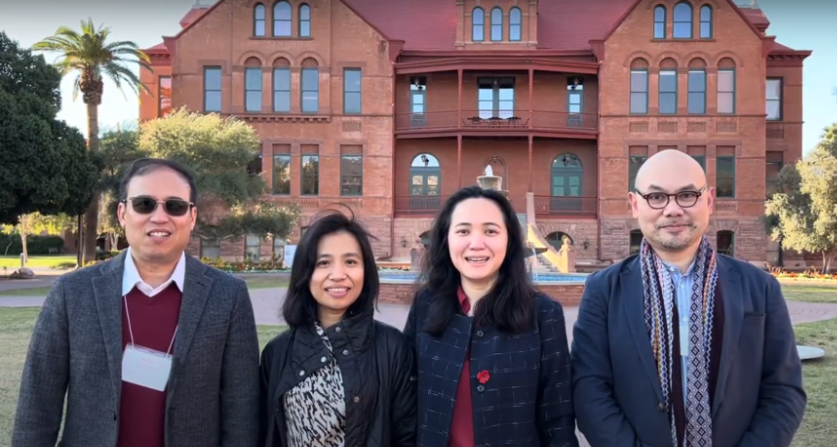
Upon receiving a grant from the International Research and Studies (IRS) program through the U.S. Department of Education, four U.S.-based Burmese language instructors have begun working on an e-textbook for intermediate level Burmese reading skills development. Project participants are:
- Chan Lwin,Program Manager, The Asia Center, Arizona State University; Burmese language instructor, Southeast Asian. Studies Summer Institute (SEASSI), University of Wisconsin-Madison
- Kenneth Wong, Burmese language instructor, University of California, Berkeley
- Maw Maw Tun, PhD Candidate, Education Technology; Burmese Teaching Assistant, Northern Illinois University
- Ye Min Tun, Adjunct Professor, Johns Hopkins School of Advanced International Studies
The grant recipients have previously collaborated on prototype lesson development and pedagogical workshops, led by Southeast Asian Language Council (SEALC) and American Council on Teaching Foreign Languages (ACTFL). The current project is largely inspired by the new insights gained from these professional development activities, they revealed.
Expected to be finalized in 2025, the finished textbook will be made available to the learners and instructors as Open Educational Resources (OER). As the first phase of the project, project team members have begun identifying authentic materials suitable for use as-is or in adapted form.
Ye Min Tun explained, “Our textbook will be a departure from standard textbooks. Instead of authoring materials to illustrate certain grammar points, we’ll be using content found in the real world as the basis for our lessons. We believe these materials more accurately reflect how people use the language in real life, so studying them better prepares learners to perform real-world tasks.”
Chan Lwin added, “The challenge is to make sure our lessons cover a range of topics and scenarios learners will likely encounter. The four of us have been meeting regularly, scouring Facebook, websites, and online journals to identify materials we can repurpose, like restaurant opening announcements, seasonal discount coupons, job vacancies, news articles, and travel blogs—even viral memes and cartoons.”
Traditional Burmese textbooks tend to treat the colloquial style and literary style as different specimens, to be taught separately. However, in authentic content culled from news sites, personal blogs, and social media, a comingling of the two is quite common.
For example, in news articles, the exposition is typically in literary style, but quoted speeches and dialogs are in colloquial style. The textbook will help learners become familiar with such mixed forms.
In the subsequent phases, the team plans to add audiovisuals and interactive elements to augment the lessons, using platforms such as Pressbooks (pressbooks.com). They plan to conduct pilot tests using select lessons from the textbook in their own classrooms, and then revise and refine the content based on their findings. Like many uncommonly taught languages, Burmese also suffers from a shortage of materials for learners and teachers. A casual search for Japanese textbooks on Amazon.com, for example, yields more than 10,000 listings. A similar search for Chinese yields more than 50,000 items. By contrast, a search for Burmese textbooks produces fewer than 100. The team hopes their textbook will fill a gap for Burmese language learners, and pave the way for similar projects in the future.
 Burma Studies Group